AI step and posture coach wristband
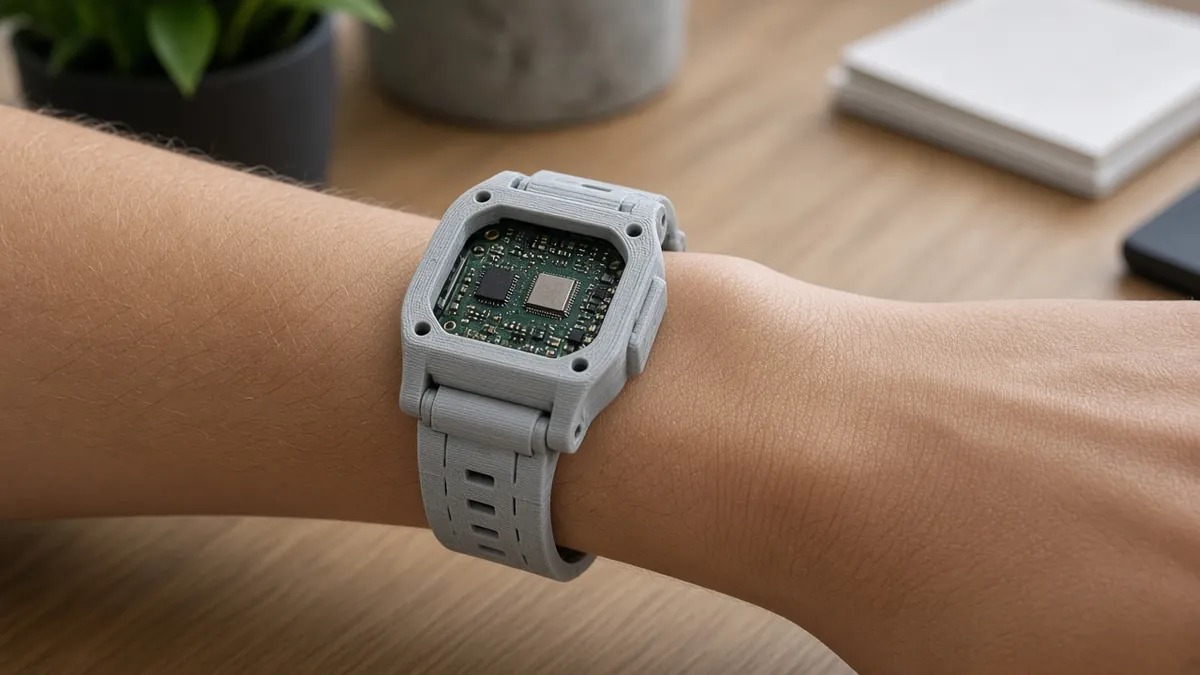
A wrist-worn ESP32-C3 or XIAO-class board with an IMU that counts steps and nags you when your wrist posture stays in a 'desk slump' range you define. A coaching toy, not a medical device.
Safety first
- This is not a medical device, not a fall detector, and not a diagnosis of posture or activity. Do not rely on it for health decisions.
- Use a protected LiPo and a proper charger. Do not charge on a pillow, do not wear it while it is charging if the pack gets warm, and stop at any swelling or odor.
- A vibration motor and a case should not grind into the skin. Pad the back and keep the case smooth.
- Small parts are a choking hazard. This is not a toy for young children.
Rules and laws
- Do not market or describe this band as a medical or ADA-accommodation device.
Parts
| Part | Qty | Approx. each | Subtotal |
|---|---|---|---|
| ESP32-C3, Seeed XIAO ESP32-C3, or similar compact boardA full ESP32-WROOM DevKit is large for a wrist but fine as a desk prototype. Typical $5-12, no verified link.Amazon (search) | 1 | $8 | $8 |
| HiLetgo GY-521 MPU-6050 6-DoF module (3-pack)Some XIAO boards already have an IMU. Typical $2.5-$4.5 each (or see pack note). ASIN confirmed. Typical $8-12 for the 3-pack; unit price is an estimate. Adafruit's official MPU-6050 (product 3886) was $12.95 on Adafruit the same day.Amazon | 1 | $3.50 | $3.50 |
| Coin or ERM vibration motorTypical $1-3, no verified link. Drive it through a transistor, not a raw GPIO, if current is high.Amazon (search) | 1 | $1.50 | $1.50 |
| Small protected single-cell LiPo, 110-300 mAh classTypical $4-10, no verified link. Do not use an unprotected cell in a wearable.Amazon (search) | 1 | $6 | $6 |
| TP4056 Type-C 5 V 1 A Li-ion/LiPo charger board with protection (multi-pack)Typical $1.2-$2.5 each (or see pack note). ASIN confirmed for a 5-pack with protection. Typical $6-10 a pack. Confirm your board includes battery protection, not charge-only.Amazon | 1 | $1.80 | $1.80 |
| Watch strap and spring barsSkip if you print a TPU strap. Typical $4-10, no verified link.Amazon (search) | 1 | $6 | $6 |
| Estimated total (parts only) | $26.80 | ||
Typical US prices, checked 2026-11-12. Prices change and multi-packs are often cheaper per piece.
As an Amazon Associate I earn from qualifying purchases. Prices change; check the store.
Filament
TPU (1.75 mm): about 25 g (8.6 m), roughly 2 h of printing.
TPU around 95A for a wrist case and strap, or a PLA case and a bought watch strap, 0.2 mm layers, 15-20% infill, usually no supports for a simple two-part case, printed slowly for TPU.
AI agents you'll use
- Firmware helper (ChatGPT, Claude, Gemini or Grok): Writes a sketch that logs IMU data, then a conservative step counter and a wrist-angle reminder, with clearly labeled thresholds that you will calibrate.
- Battery safety helper: Reviews that the cell is protected, the charger is appropriate, and the case will not crush or puncture the pack.
Tools
- 3D printer
- Soldering iron or a fine USB board with headers
- Computer to flash firmware
- Optional sewing tools if you add a fabric strap
What you'll learn
- Reading an MPU6050 or similar IMU in a small battery-powered board
- A simple step-detection idea and its limits
- Charging a small LiPo safely with a protected pack and a proper charger module
- Why consumer IMUs are not clinical posture sensors
A wrist IMU can roughly count steps and notice that your wrist has been in one position for a long time. That is interesting enough to build, and not accurate enough to call medicine. You will calibrate thresholds on your own arm.
What you'll build
A small printed case on a strap, a compact ESP32-class board, an IMU, a vibration motor, and a protected single-cell LiPo with a proper charger. A first firmware only streams angles over USB; coaching comes after you look at real data.
Print the parts
Search Printables or Thingiverse for a "XIAO watch case" or "ESP32-C3 wrist case" that has room for your exact board and cell, and credit the designer. The cell must not be bent or tightly crushed. Print the case in TPU or use PLA with a bought strap.
Wiring
Example for a separate MPU6050 and a small motor on an ESP32-C3. Confirm pins for your board; some C3 boards have a limited pinout.
| From | To |
|---|---|
| IMU VCC | 3.3 V |
| IMU GND | GND |
| IMU SDA / SCL | The board's documented I2C pins (often GPIO 6 and 7 on a XIAO-class board - confirm yours) |
| Vibration motor | A transistor or driver, then a GPIO, plus a flyback diode if the driver does not include one. Do not overload a GPIO. |
| Protected LiPo | The charger's battery pads, with polarity checked twice |
| USB-C | Only the official charge or data port on the charger/board |
Step-by-step
- On a breadboard, read the IMU over USB and plot pitch and roll while you move your wrist. Confirm the axis map.
- Record a short walk and a short typing session. Ask the firmware helper to draft a step heuristic and a "held still in this angle band for N minutes" reminder, with all thresholds labeled.
- Add the motor last, with a driver, and test a short buzz on the bench.
- Fit the protected cell and charger in the printed case so nothing is pinched. Do a first charge in a fire-safe place, not on the bed, and not on your wrist.
- Wear it around the house and retune thresholds. It will miscount; treat that as normal.
- Add a way to turn coaching off, and a clearly written "not a medical device" note in your own README.
Code
Prompt for the helper:
Write an Arduino sketch for an ESP32-C3 and an MPU6050 that prints timestamped wrist angles over Serial, then (in clearly separated functions) a conservative step count heuristic and a reminder if the wrist angle stays in a user-labeled band for N minutes.
I will paste my I2C pins. Do not claim medical accuracy. Keep the vibration pin off until I define it. Comment the axis mapping.
Look at the Serial plot before you believe any count.
Troubleshooting
- Angles drift or jump: the IMU is loose, or you need to confirm a stable I2C supply.
- Step count doubles: your threshold is too sensitive. Log data and raise it.
- The charger gets hot: unplug and re-check the cell chemistry, polarity, and that the board includes protection. Do not keep using a hot pack.
- The case hurts: print a TPU pad or switch to a bought strap. Do not wear a sharp PLA edge all day.
Files, code and docs
- Adafruit MPU6050 library (BSD-3-Clause)
- Installing the Arduino-ESP32 core (Espressif docs) (Vendor docs)
Last checked 2026-11-12. Double-check parts against your own board and seller listings before you buy.