Haptic navigation belt
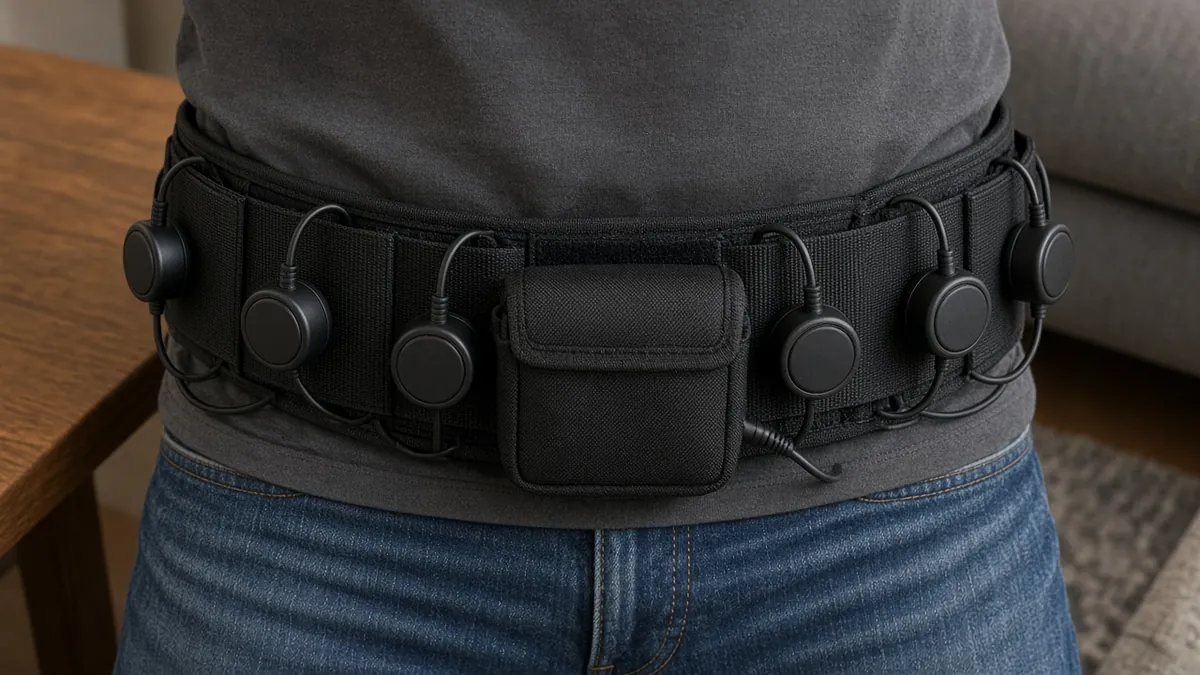
A belt with several vibration motors around your waist that buzzes in the direction you should walk, driven by an ESP32 and a phone or a GPS heading. A training and accessibility experiment, not your only way to cross a street.
Safety first
- Do not use this belt as your only way to navigate near traffic, transit platforms, or water. Eyes, ears, a cane, and a human companion still come first.
- Lost-signal behavior must be 'all motors off' plus a distinct alert, not a frozen 'go this way' buzz.
- Keep motors from overheating against bare skin. Use a fabric layer and a way to power off immediately.
- This is low-voltage electronics. No mains wiring. Use a quality power bank.
Rules and laws
- This is not a certified accessibility device or a medical product. Do not sell or describe it as one.
- If you record GPS tracks, treat them as personal location data.
Parts
| Part | Qty | Approx. each | Subtotal |
|---|---|---|---|
| Espressif ESP32-DevKitC-32E (DevKitC V4) development boardBLE is used if a phone supplies the heading. This is a full-size 38-pin DevKit and is bulky on a belt. Official Espressif 38-pin DevKitC V4 with ESP32-WROOM-32E (4 MB). Micro-USB port, not USB-C. Buy only the official 38-pin Micro-USB board, not a USB-C or 30-pin clone. Primary listing: Mouser 356-ESP32-DEVKITC32E, $10.20, 1,701 in stock on Nov 12, 2026, per Findchips (https://www.findchips.com/search/ESP32-DEVKITC-32E). The Mouser US page itself returned 403 to a direct fetch, so click-confirm the US storefront before you order. Mouser Netherlands listed 1,622 in stock at €8.60 the same day. Do not use DigiKey as the default today (search snippets showed 0 in stock / long lead time). Official Amazon listing https://www.amazon.com/dp/B09MQJWQN2 was still unavailable; use it if it returns. Amazon search for the official board: https://www.amazon.com/s?k=ESP32-DevKitC-32E. Adafruit #3269 remains $15.00 and was out of stock (https://www.adafruit.com/product/3269). Typical $10-16.Mouser · price seen on 2026-11-12 | 1 | $10.20 | $10.20 |
| Coin or ERM vibration motorFour motors already work for a first version (front, right, back, left). Typical $1-3, no verified link. Drive it through a transistor, not a raw GPIO, if current is high.Amazon (search) | 8 | $1.50 | $12 |
| Transistor array or MOSFET board for several vibration motorsTypical $4-10, no verified link.Amazon (search) | 1 | $6 | $6 |
| USB power bank, 5 V, quality pack with an obvious switchTypical $12-25, no verified link.Amazon (search) | 1 | $15 | $15 |
| Comfortable belt and a wiring harnessTypical $8-15, no verified link.Amazon (search) | 1 | $10 | $10 |
| GNSS plus compass module, if you do not use a phone headingOptional if you do not use a phone. Typical $12-25, no verified link.Amazon (search) | 1 | $15 | $15 |
| Estimated total (parts only) | $68.20 | ||
Typical US prices, checked 2026-11-12. Prices change and multi-packs are often cheaper per piece.
As an Amazon Associate I earn from qualifying purchases. Prices change; check the store.
Filament
PLA (1.75 mm): about 50 g (16.8 m), roughly 4 h of printing.
PLA or PETG for motor clips, 0.2 mm layers, 20% infill, usually no supports for simple clips. You can also sew pouches and skip most of the print.
AI agents you'll use
- Firmware helper (ChatGPT, Claude, Gemini or Grok): Writes an ESP32 sketch that maps a heading error to one or two motors, with a timeout that turns all motors off if the phone or GPS goes quiet.
- Safety helper: Helps you plan tests in a quiet yard, never as the only navigation method near traffic.
Tools
- Sewing kit or a bought belt
- Soldering iron
- Computer to flash the ESP32
- Optional 3D printer
- Multimeter
What you'll learn
- Driving several vibration motors through transistors or a driver board
- Sending a heading from a phone over BLE, or using a GPS/compass module
- Why haptics need to be obvious without being painful
- Failing safe when the signal is lost
Feel-space style belts have been built in labs for years: buzz left to turn left, buzz ahead to go forward. You can make a training version with an ESP32 and a handful of motors. It is a good haptic project, and a bad thing to trust at a crosswalk.
What you'll build
A belt with four or eight motor pods, a driver, an ESP32, and a power bank. A first version is "I type a heading on the serial port and the right motor buzzes." A second version takes a heading from a phone over BLE, or from a GPS/compass module you documented.
Print the parts
Print simple clips that sew or snap onto a belt, or skip printing and sew pouches. Search Printables or Thingiverse for "haptic motor belt clip" if you want a starting file, and credit the designer.
Wiring
Example for four motors. Extend the same idea to eight only with a driver that can handle the current.
| From | To |
|---|---|
| Power bank 5 V and GND | Motor supply and ESP32 ground (common ground) |
| Each motor | A driver channel, never a raw GPIO, with a flyback path |
| Driver inputs | ESP32 GPIOs, for example 16, 17, 18, 19 for four motors |
| Optional phone | BLE to the ESP32, no special wire |
| Optional GPS/compass | The module's documented UART or I2C pins |
Step-by-step
- On the bench, drive one motor through a transistor and confirm it is noticeable but not painful against your palm.
- Mount four motors at front, right, back and left on a belt. Number them and write the map down.
- Flash a sketch that buzzes one motor based on a serial command (N, E, S, W). Walk around a room with your eyes open and a friend spotting you.
- Add a heading-error function: a target heading in, the nearest motor or pair out, all motors off if no update arrives for a second or two.
- Only then hook a phone compass or a GPS path, still in a quiet yard or hall, eyes open.
- Add a big off switch. Do not take it to a busy street as your navigator.
Code
Prompt for the helper:
Write an Arduino-ESP32 sketch that drives four vibration motors through driver pins 16, 17, 18 and 19 (front, right, back, left).
Accept a target heading and a current heading (I will later fill in BLE or Serial values) and buzz the motor closest to the error.
If no heading update arrives for 1.5 seconds, turn all motors off and set a 'signal lost' flag. Do not drive motors from a GPIO without a driver in the comments. This is not a medical or street-navigation device.
Troubleshooting
- All motors feel the same: they are too close together, or the buzz is too long. Use short pulses and more spacing.
- ESP32 resets: the motors are pulling the logic supply down. Power them from the bank, common ground only, through a driver.
- BLE heading is jittery: filter it, and keep the lost-signal timeout.
- Compass disagrees with the street: magnetic interference from the power bank. Move the compass or do not trust it.
Files, code and docs
- Installing the Arduino-ESP32 core (Espressif docs) (Vendor docs)
Last checked 2026-11-12. Double-check parts against your own board and seller listings before you buy.