Motorized camera slider with time-lapse control
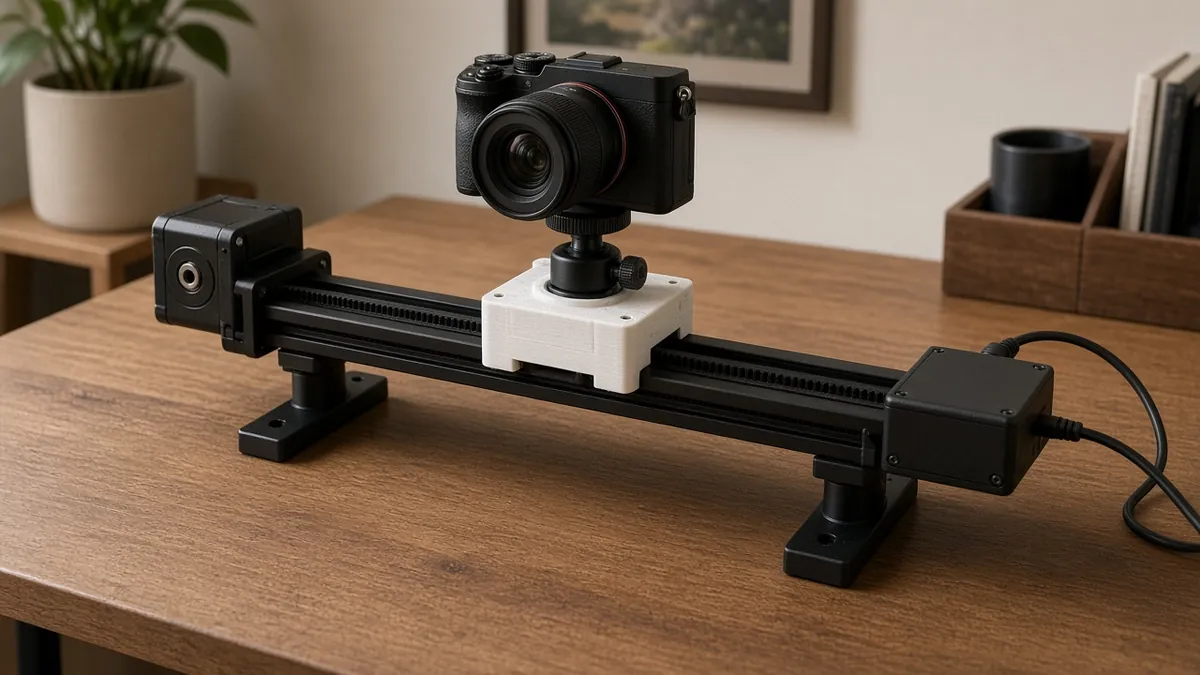
A 50 cm aluminum-rail camera slider with a quiet NEMA 17 stepper on a TMC2209 driver, belt-driven carriage and ball head. An ESP32 serves a phone web page to set smooth video moves or slow time-lapse sweeps.
Safety first
- Keep fingers and hair away from the belt and pulley while it moves. Add a stop button on the web page and a physical endstop.
- Set the TMC2209 current before connecting the motor, and never unplug the motor while the driver is powered; that can destroy the driver.
- Use a listed 12 V supply, and weight or clamp the slider so a camera cannot tip it over.
Parts
| Part | Qty | Approx. each | Subtotal |
|---|---|---|---|
| 2020 V-slot aluminum extrusion, 500 mmTypical $8-14, no verified link.Amazon (search) | 1 | $10 | $10 |
| 2020 V-slot gantry plate with 4 wheelsTypical $11-20, no verified link.Amazon (search) | 1 | $15 | $15 |
| 17HS4401 NEMA 17 stepper motorTypical $10-16, no verified link.Amazon (search) | 1 | $12 | $12 |
| BIGTREETECH TMC2209 stepper driverVery quiet in StealthChop mode, good for video. Typical $6-12, no verified link.Amazon (search) | 1 | $8 | $8 |
| GT2 belt, 20T pulley and idler kitTypical $9-16, no verified link.Amazon (search) | 1 | $12 | $12 |
| Espressif ESP32-DevKitC-32E (DevKitC V4) development boardOfficial Espressif 38-pin DevKitC V4 with ESP32-WROOM-32E (4 MB). Micro-USB port, not USB-C. Buy only the official 38-pin Micro-USB board, not a USB-C or 30-pin clone. Primary listing: Mouser 356-ESP32-DEVKITC32E, $10.20, 1,701 in stock on Nov 12, 2026, per Findchips (https://www.findchips.com/search/ESP32-DEVKITC-32E). The Mouser US page itself returned 403 to a direct fetch, so click-confirm the US storefront before you order. Mouser Netherlands listed 1,622 in stock at €8.60 the same day. Do not use DigiKey as the default today (search snippets showed 0 in stock / long lead time). Official Amazon listing https://www.amazon.com/dp/B09MQJWQN2 was still unavailable; use it if it returns. Amazon search for the official board: https://www.amazon.com/s?k=ESP32-DevKitC-32E. Adafruit #3269 remains $15.00 and was out of stock (https://www.adafruit.com/product/3269). Typical $10-16.Mouser | 1 | $10.20 | $10.20 |
| LM2596 buck converter module (4-pack)One module set to 5 V powers the ESP32 from the 12 V supply. Typical $7-13, no verified link.Amazon (search) | 1 | $10 | $10 |
| 12 V 3 A DC power supplyTypical $9-16, no verified link.Amazon (search) | 1 | $12 | $12 |
| 100 uF 35 V electrolytic capacitorAcross the driver motor power input. Typical $0.3-2, no verified link.Amazon (search) | 1 | $0.50 | $0.50 |
| Mechanical endstop switch (3-pack)Typical $4-9, no verified link.Amazon (search) | 1 | $6 | $6 |
| 1/4-20 mini ball headTypical $9-18, no verified link.Amazon (search) | 1 | $12 | $12 |
| M5 T-nuts and M3/M5 screw kitTypical $9-16, no verified link.Amazon (search) | 1 | $12 | $12 |
| Estimated total (parts only) | $119.70 | ||
Typical US prices, checked 2026-11-12. Prices change and multi-packs are often cheaper per piece.
As an Amazon Associate I earn from qualifying purchases. Prices change; check the store.
Filament
PETG (1.75 mm): about 250 g (82.5 m), roughly 14 h of printing.
PETG, 0.2 mm layers, 30% infill, 4 walls for the end plates and carriage.
AI agents you'll use
- Code helper (ChatGPT, Claude, Gemini or Grok): Writes the ESP32 sketch: homing with the endstop, AccelStepper ramps, and a phone web page for start, end, duration and time-lapse steps.
- Shot planner: Turns "a 10-second dolly-in" or "a 2-hour sunset time-lapse" into slider settings and camera interval settings.
Tools
- Hex keys
- Small screwdriver
- Soldering iron
- Multimeter (to set the driver current)
- Phone for the web UI
What you'll learn
- Stepper motion with acceleration ramps
- Setting current on a TMC2209
- Belt tension and smooth carriages
- Serving a control page from an ESP32
Smooth, repeatable camera moves make simple footage look cinematic. This slider does slow dolly shots and hours-long time-lapse sweeps from your phone.
What you'll build
A 500 mm V-slot rail on printed end plates and legs. A gantry plate with four wheels rides the rail, pulled by a GT2 belt from a NEMA 17 at one end around an idler at the other. A TMC2209 drives the motor silently; an ESP32 hosts a web page to set start and end points, move time, and time-lapse steps. An endstop gives a repeatable home position. For time-lapse, the slider moves in small steps and pauses; your camera's own interval timer (or a remote) takes the shots during the pauses.
The cost range is $105-135 for the parts listed below, allowing about 10% either way for price swings.
Print the parts
Print the motor end plate, idler end plate, legs, carriage adapter and electronics box. Search Printables for a "2020 V-slot camera slider", check the license, and credit the designer.
Wiring
| From | To | Notes |
|---|---|---|
| 12 V supply | TMC2209 VM and GND, and LM2596 input | 100 uF capacitor across VM and GND near the driver. |
| LM2596 output (5 V) | ESP32 5V/VIN | Set it to 5.0 V before connecting. |
| TMC2209 STEP / DIR / EN | ESP32 GPIO26 / GPIO27 / GPIO25 | EN is active LOW. |
| TMC2209 VIO / GND | ESP32 3V3 / GND | Logic supply. |
| TMC2209 A1/A2/B1/B2 | NEMA 17 coils | Check the coil pairs with a multimeter. |
| Endstop | ESP32 GPIO33 and GND | INPUT_PULLUP. |
Step-by-step
- Print the parts and assemble the rail, end plates, carriage and belt.
- Set the LM2596 to 5 V and the TMC2209 current (Vref) for the 17HS4401 per the driver docs.
- Wire the driver, endstop and ESP32; test a slow move with the belt off.
- Fit the belt and tension it until it twangs lightly.
- Flash the web-UI sketch with homing, video-move and time-lapse modes.
- Test with a camera-weight dummy before trusting your real camera to it.
Code
Arduino-ESP32 with AccelStepper and the built-in WebServer library.
Prompt for the code helper:
Write an Arduino-ESP32 sketch for a camera slider: TMC2209 STEP GPIO26, DIR GPIO27, EN GPIO25 (active LOW), 1/16 microstepping, GT2 belt with a 20-tooth pulley (40 mm per rev), endstop on GPIO33.
Home on boot. Serve a phone web page with: video move (start mm, end mm, seconds, ease in/out), time-lapse (start, end, shots, interval, move-then-pause), and a big STOP button. Use AccelStepper with acceleration and never exceed the rail length of 420 mm of travel.
Troubleshooting
- Motor hums but does not move: Coil pairs are mixed up or current too low. Check the pairs.
- Jerky video: Acceleration too high or the belt is loose. Lower acceleration and tension the belt.
- Driver gets hot: Current set too high; lower Vref and add a heatsink.
Files, code and docs
- AccelStepper library (Mike McCauley) (GPL-3.0)
- BIGTREETECH TMC2209 documentation (Vendor docs)
- Installing the Arduino-ESP32 core (Espressif docs) (Vendor docs)
Last checked 2026-11-12. Double-check parts against your own board and seller listings before you buy.