Robotic chess board
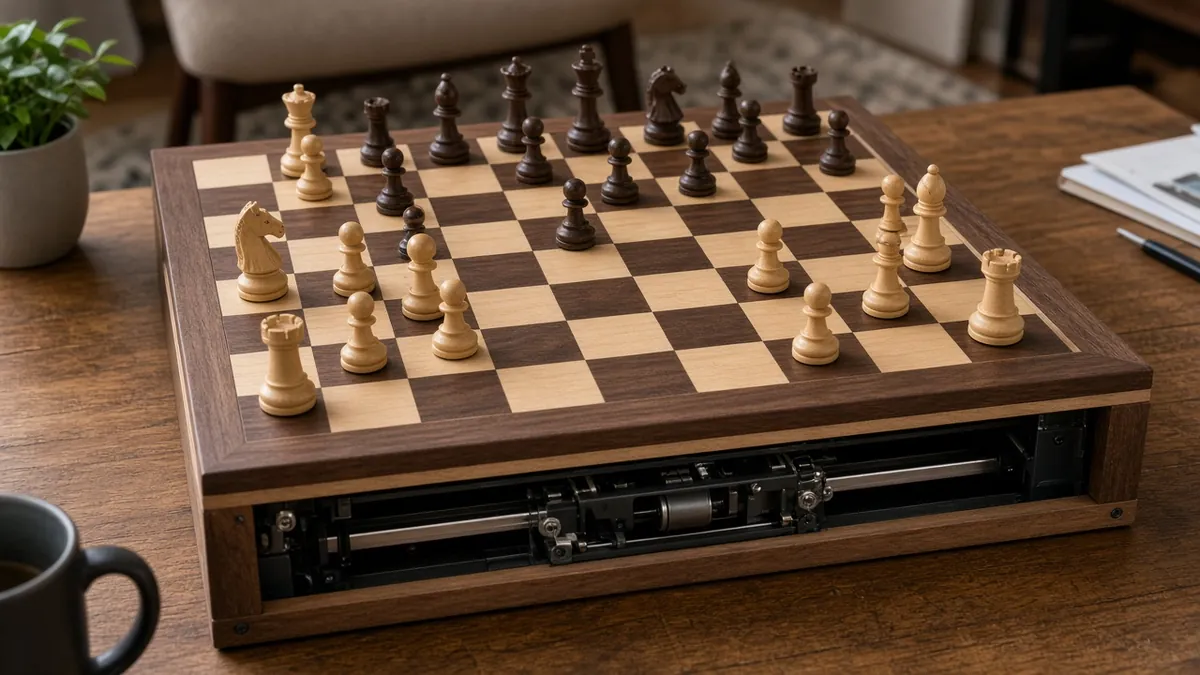
A tabletop chess board with an under-board XY gantry and a magnet that moves the pieces, plus a chess engine such as official Stockfish. A long, careful build, not a weekend toy.
Safety first
- The gantry can pinch fingers. Work with power off when your hands are under the board, and keep the first moves slow.
- Neodymium magnets can pinch skin and are a serious hazard if swallowed. Keep them away from children and from magnetically sensitive devices.
- Use a listed 12 V supply. No mains wiring inside the board.
- A fast-spinning motor or a flying loose magnet is a stop-and-fix condition, not a 'one more test' condition.
Rules and laws
- Stockfish and GRBL are GPL-licensed software; follow those licenses if you distribute a packaged image.
- This is a home robot, not a tournament-certified board.
Parts
| Part | Qty | Approx. each | Subtotal |
|---|---|---|---|
| XY gantry: NEMA 17s, belts, rails, GRBL-class controllerTypical $60-120, no verified link.Amazon (search) | 1 | $80 | $80 |
| Neodymium magnet, a small lift, and chess pieces with ferrous basesMagnets can pinch; keep them away from children. Typical $15-35, no verified link.Amazon (search) | 1 | $25 | $25 |
| Thin, accurately squared play surfaceTypical $15-30, no verified link.Amazon (search) | 1 | $20 | $20 |
| Raspberry Pi 4 Model B 2GB (or a spare computer)Enough for Stockfish at modest levels. Skip it if you have a spare computer. Typical $45-60, no verified link.Amazon (search) | 1 | $45–$60 | $45–$60 |
| Optional overhead camera or a hall/reed matrix from a complete designTypical $15-40, no verified link.Amazon (search) | 1 | $25 | $25 |
| Listed 12 V DC supply for steppers, sized to the driversKeep the mains brick outside the board. Typical $15-25, no verified link.Amazon (search) | 1 | $18 | $18 |
| Estimated total (parts only) | about $220.50 | ||
Typical US prices, checked 2026-11-12. Prices change and multi-packs are often cheaper per piece. Where a store hides the exact price we show a range, and the total uses the middle of it.
As an Amazon Associate I earn from qualifying purchases. Prices change; check the store.
Filament
PLA (1.75 mm): about 500 g (167.8 m), roughly 30 h of printing.
PLA or PETG, 0.2 mm layers, 25% infill, 3-4 walls, supports on gantry parts as the design requires. This is a large print job - confirm grams and hours in your slicer, and consider mixing a wooden frame with printed carriages. The 500 g / 30 h estimate assumes a wood or acrylic play surface with only the gantry, carriages and maybe the pieces printed; a fully printed board, frame and pieces is often 1-1.5 kg and 50-80 h.
AI agents you'll use
- Motion and engine helper (ChatGPT, Claude, Gemini or Grok): Helps you keep GRBL travel limits, a square-to-coordinate map, and official Stockfish or UCI commands separate, and refuses to invent a full sensor-matrix firmware for an unspecified board.
- Mechanical helper: Reviews square size, magnet lift, and cable routing under the board.
Tools
- 3D printer
- Wood or acrylic tools if you mix materials
- Soldering iron
- Calipers
- Computer to run GRBL or a similar controller, plus Stockfish
- Multimeter
What you'll learn
- Building a slow, accurate XY gantry under a thin board
- Talking to a documented chess engine
- Detecting moves with a camera or with a sensor matrix, at a basic level
- Why magnet polarity, piece slop, and square alignment eat whole weekends
A robot chess board is a slow plotter that happens to play chess. Under the table, a gantry parks a magnet under a square, lifts, and drags a piece. Above the table, Stockfish (or another UCI engine) chooses a move. Expect alignment work, not magic.
What you'll build
An under-board XY mechanism, a magnet lift, a play surface with accurate squares, and a computer running official Stockfish talking to official GRBL (or another documented controller). Move input can start as "type the move" and later become a camera or a sensor matrix if you follow a complete design.
The $150-350 range is a planning figure; a fully documented community project with a camera can sit at the top of it.
Print the parts
Search for an open-licensed robotic chess board or "chess gantry" design with a bill of materials, and credit the designer. If you cannot find a complete, licensed design, print only carriages and mix them with a wooden frame, and be honest that you are doing mechanical design work.
Confirm square size (often 50 mm class, but use your design) and piece base diameter in the slicer and with calipers. The 500 g / 30 h figures are planning estimates.
Wiring
Use the official GRBL or controller map for your shield, as in the pen-plotter project.
| Function | Typical connection | Notes | |---|---| | X and Y steppers | Controller driver sockets | Set current from the driver datasheet. | | Magnet lift | A servo on a documented pin, or a Z axis | Test with no pieces first. | | 12 V supply | Driver power, common ground with logic | Keep the mains brick outside the box. | | USB serial | Computer or Pi running Stockfish and a small Python sender | | | Optional camera | A USB camera on the Pi, aimed straight down | Lighting has to be even. |
Step-by-step
- Build and jog the gantry without the board, then with the board, until a marker on the magnet visits every square center within a couple of millimeters.
- Flash official GRBL, set travel limits, and write a square-to-coordinate table you can edit.
- Add the magnet lift. Practice sliding one pawn without tipping its neighbors.
- Install official Stockfish on the Pi or laptop and confirm you can get a best move from a FEN or a UCI position in a terminal.
- Write a small program: you type a move, the engine replies, the gantry moves the piece, and captured pieces go to a documented drop square.
- Only later add move detection (a documented camera pipeline, or a sensor matrix from a complete design).
- Add an emergency stop on the motor supply, and a rule that humans keep fingers off the board while it is moving.
Code
Prompt for the helper:
Help me outline a Python program that talks to official Stockfish over UCI and sends conservative g-code to a GRBL controller to move a chess piece from one square to another, using an editable square-to-coordinate table and a magnet-up / magnet-down command.
Do not invent GRBL pin maps or Stockfish flags. Point me to official UCI and GRBL docs. First version: I type both the player's move and the confirmation that the board is clear.
Get manual "move e2 to e4" working before you add a camera.
Troubleshooting
- Pieces drift off square: steps/mm, belt tension, or a board that is not flat. Measure, do not guess.
- Two pieces attract or a dragged piece tips: magnet too strong or too close, or the path needs to go via an empty margin.
- Stockfish plays but the gantry is late: serial is blocked, or your motion is not waiting for GRBL "ok".
- Camera misreads a move: lighting, lens angle, or you skipped the typed-move version. Go back a step.
Files, code and docs
- Stockfish official site (GPL-3.0)
- GRBL firmware (gnea/grbl) (GPL-3.0)
Last checked 2026-11-12. Double-check parts against your own board and seller listings before you buy.