Smart backpack with wireless turn signals and a brake light
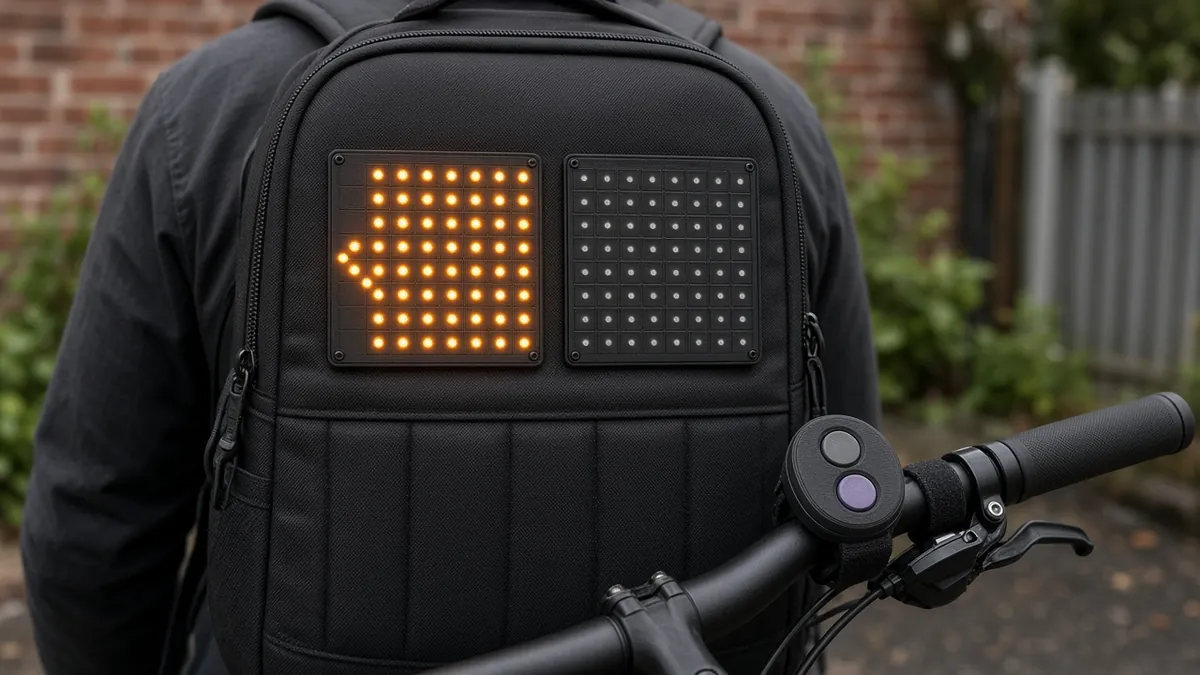
Two 8x8 LED panels on your backpack show left and right arrows when you press buttons on a small handlebar remote, and flash red when an MPU-6050 feels you slow down. An ESP32 in the backpack and a battery-powered XIAO ESP32-C3 remote talk over ESP-NOW, no phone needed.
Safety first
- This is a fun extra, not a certified safety light. Keep your legally required front and rear bike lights and reflectors, and still use hand signals.
- Test the remote before every ride and never look down at the panels while riding.
- Use a protected LiPo cell for the remote, check polarity before soldering it to the XIAO pads, and do not charge it in the sun or unattended.
- Cap the panel brightness in code: 128 LEDs at full white can draw several amps, more than a power bank port supplies.
Rules and laws
- Lighting rules for bicycles vary by state and country (for example, some limit flashing or colored lights). Check your local vehicle code; this does not replace required lights.
Parts
| Part | Qty | Approx. each | Subtotal |
|---|---|---|---|
| Espressif ESP32-DevKitC-32E (DevKitC V4) development boardOne board in the backpack. Official Espressif 38-pin DevKitC V4 with ESP32-WROOM-32E (4 MB). Micro-USB port, not USB-C. Buy only the official 38-pin Micro-USB board, not a USB-C or 30-pin clone. Primary listing: Mouser 356-ESP32-DEVKITC32E, $10.20, 1,701 in stock on Nov 12, 2026, per Findchips (https://www.findchips.com/search/ESP32-DEVKITC-32E). The Mouser US page itself returned 403 to a direct fetch, so click-confirm the US storefront before you order. Mouser Netherlands listed 1,622 in stock at €8.60 the same day. Do not use DigiKey as the default today (search snippets showed 0 in stock / long lead time). Official Amazon listing https://www.amazon.com/dp/B09MQJWQN2 was still unavailable; use it if it returns. Amazon search for the official board: https://www.amazon.com/s?k=ESP32-DevKitC-32E. Adafruit #3269 remains $15.00 and was out of stock (https://www.adafruit.com/product/3269). Typical $10-16.Mouser | 1 | $10.20 | $10.20 |
| Seeed Studio XIAO ESP32-C3The remote. Has a built-in LiPo charger on its battery pads. Typical $5-9, no verified link.Amazon (search) | 1 | $6 | $6 |
| BTF-LIGHTING WS2812B 8x8 flexible LED panelTypical $7-13, no verified link.Amazon (search) | 2 | $9 | $18 |
| HiLetgo GY-521 MPU-6050 IMU (3-pack)Mounted flat in the backpack box for brake detection. Catalog ASIN, sold as a 3-pack. Typical $9-14.Amazon | 1 | $10.50 | $10.50 |
| 16 mm waterproof momentary push button (pack)Two used on the remote: left and right. Typical $6-12, no verified link.Amazon (search) | 1 | $9 | $9 |
| 3.7 V 400 mAh protected LiPo (602535 size)Soldered to the XIAO battery pads; charges over the XIAO USB-C. Typical $6-11, no verified link.Amazon (search) | 1 | $8 | $8 |
| Anker PowerCore 10000 USB power bankSkip if you already own one. Powers the backpack ESP32 and panels. Typical $18-28, no verified link.Amazon (search) | 1 | $22 | $22 |
| White translucent acrylic diffuser sheetTypical $6-12, no verified link.Amazon (search) | 1 | $9 | $9 |
| Silicone-insulated 22 AWG wire kitTypical $9-15, no verified link.Amazon (search) | 1 | $12 | $12 |
| Handlebar phone mount strap (silicone)Typical $5-10, no verified link.Amazon (search) | 1 | $8 | $8 |
| Estimated total (parts only) | $112.70 | ||
Typical US prices, checked 2026-11-12. Prices change and multi-packs are often cheaper per piece.
As an Amazon Associate I earn from qualifying purchases. Prices change; check the store.
Filament
PETG (1.75 mm): about 120 g (39.6 m), roughly 7 h of printing.
PETG, 0.2 mm layers, 25% infill, 3 walls; PETG handles sun and rain better than PLA.
AI agents you'll use
- Code helper (ChatGPT, Claude, Gemini or Grok): Writes both sketches: the remote (buttons to ESP-NOW messages, low-power sleep) and the backpack (arrow animations, brake detection, timeout).
- Brake-detection tuner: Looks at accelerometer logs you record while riding and suggests a threshold and filter that catches real stops without false alarms.
Tools
- Soldering iron
- Wire stripper
- Hot glue gun
- Needle and strong thread or Velcro
- USB data cable
What you'll learn
- ESP-NOW wireless between two ESP32 boards
- Animating LED matrices
- Detecting braking from accelerometer data
- Battery power for wearables
Signal your turns where drivers actually look: at your back. Tap the handlebar remote and a bright arrow appears on your backpack; slow down and it flashes red.
What you'll build
Two flexible 8x8 WS2812B panels behind a diffuser on the back of a backpack, driven by an ESP32 and a power bank inside. A small remote on the handlebar with two buttons, a XIAO ESP32-C3 and a 400 mAh LiPo sends ESP-NOW messages and sleeps between presses. Arrows blink for 10 seconds or until you press again. An MPU-6050 in the backpack box watches for sustained deceleration and flashes both panels red.
The cost range is $80-125. The low end assumes you already own these items marked "skip if you already own one": Anker PowerCore 10000 USB power bank. The high end includes them.
Print the parts
Print a slim backpack box for the ESP32 and MPU-6050, two panel frames with diffuser slots, and a small two-button remote case that straps to the handlebar. Ask the AI helper to help you design them, or credit any designer you remix.
Wiring
Backpack side:
| From | To | Notes |
|---|---|---|
| Power bank USB | Backpack ESP32 USB and both panels' 5V | Use a USB breakout or a cut cable for the panel feed. |
| ESP32 GPIO5 | Left panel DIN, then left DOUT to right panel DIN | One chain of 128 LEDs. |
| MPU-6050 SDA / SCL | ESP32 GPIO21 / GPIO22 | 3V3 and GND. |
| Remote: left / right buttons | XIAO D0 (GPIO2) / D1 (GPIO3) and GND | INPUT_PULLUP; GPIO0-5 can wake the ESP32-C3 from deep sleep. |
| Remote: LiPo | XIAO BAT+ / BAT- pads on the underside | Check polarity; the XIAO charges it from USB-C. |
Step-by-step
- Test both boards with an ESP-NOW ping and note the backpack board's MAC address.
- Wire the panels and write the arrow and brake animations at 25% brightness.
- Wire the remote buttons and send left/right/cancel messages.
- Log accelerometer data on a ride (with the panels off) and tune brake detection with the helper.
- Print the boxes and mount the panels behind the diffuser.
- Put the remote into deep sleep between presses to save its battery.
- Test in a parking lot before riding in traffic.
Code
Two Arduino-ESP32 sketches using ESP-NOW and FastLED, plus any maintained MPU-6050 library.
Prompt for the code helper:
Write two Arduino-ESP32 sketches. Remote (Seeed XIAO ESP32-C3): buttons on GPIO2 (left) and GPIO3 (right), INPUT_PULLUP; on press send a 1-byte ESP-NOW message (1=left, 2=right, 0=cancel if pressed again) to MAC <paste>, then deep sleep with esp_deep_sleep_enable_gpio_wakeup on both pins (wake on LOW).
Backpack: 128 WS2812B (two 8x8 panels in series) on GPIO5 with FastLED at max brightness 64; show a blinking amber arrow on the matching panel for 10 s; read an MPU-6050 at 0x68 and flash both panels red when filtered forward deceleration exceeds THRESH for 300 ms.
Troubleshooting
- Remote presses are missed: The remote is asleep too deeply or out of range. Check the wake pins and antenna position.
- Brake light flashes on bumps: Filter the accelerometer and require the deceleration to last a few hundred milliseconds.
- Panels flicker or reset: Brightness too high for the power bank. Lower it.
Files, code and docs
- ESP-NOW documentation (Espressif) (Vendor docs)
- FastLED library (MIT)
- Installing the Arduino-ESP32 core (Espressif docs) (Vendor docs)
Last checked 2026-11-12. Double-check parts against your own board and seller listings before you buy.