Smart plant waterer
A capacitive soil sensor and a small pump on an ESP32 that waters a houseplant when the soil actually needs it. Optional ESPHome and Home Assistant hooks, with a simple on-device fallback.
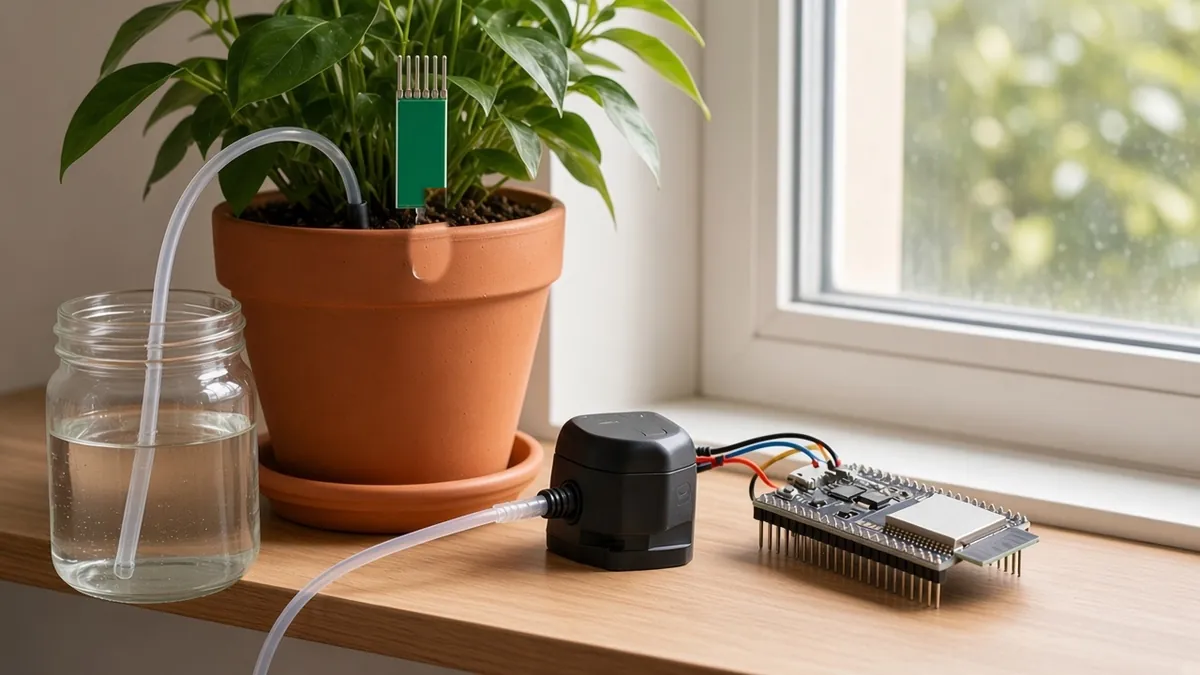
Safety first
- Water and electronics do not mix. Keep the ESP32, supply and MOSFET above the reservoir, and never leave a new pump unattended the first few times it runs.
- Cap the maximum pump time (a few seconds) and add a daily maximum so a failed sensor cannot soak a floor or a power strip.
- Use a listed 5 V USB supply. This is a low-voltage project; no mains wiring.
- Do not run a submersible pump dry for long periods if the maker says it needs to be wet.
Parts
| Part | Qty | Approx. each | Subtotal |
|---|---|---|---|
| Espressif ESP32-DevKitC-32E (DevKitC V4) development boardOfficial Espressif 38-pin DevKitC V4 with ESP32-WROOM-32E (4 MB). Micro-USB port, not USB-C. Buy only the official 38-pin Micro-USB board, not a USB-C or 30-pin clone. Primary listing: Mouser 356-ESP32-DEVKITC32E, $10.20, 1,701 in stock on Nov 12, 2026, per Findchips (https://www.findchips.com/search/ESP32-DEVKITC-32E). The Mouser US page itself returned 403 to a direct fetch, so click-confirm the US storefront before you order. Mouser Netherlands listed 1,622 in stock at €8.60 the same day. Do not use DigiKey as the default today (search snippets showed 0 in stock / long lead time). Official Amazon listing https://www.amazon.com/dp/B09MQJWQN2 was still unavailable; use it if it returns. Amazon search for the official board: https://www.amazon.com/s?k=ESP32-DevKitC-32E. Adafruit #3269 remains $15.00 and was out of stock (https://www.adafruit.com/product/3269). Typical $10-16.Mouser · price seen on 2026-11-12 | 1 | $10.20 | $10.20 |
| Analog capacitive soil moisture sensor v2.0 (multi-pack listings)Typical $2.5-$5 each (or see pack note). ASIN confirmed for a 3-pack listing. Typical $8-15 a pack. Calibrate in your soil.Amazon | 1 | $3.50 | $3.50 |
| DC 5 V micro peristaltic / dosing pumpTypical $8-$15 each (or see pack note). ASIN confirmed. Typical $8-15. Do not drive the motor from an ESP32 pin.Amazon | 1 | $10 | $10 |
| Logic-level MOSFET module or 5 V relay moduleTypical $3-7, no verified link.Amazon (search) | 1 | $4 | $4 |
| 5 V, 2 A USB wall adapterA 2 A adapter is a starting point, not a measurement of your pump. Typical $5-10, no verified link.Amazon (search) | 1 | $7 | $7 |
| Tubing and a reservoir bottleTypical $3-8, no verified link.Amazon (search) | 1 | $5 | $5 |
| Estimated total (parts only) | $39.70 | ||
Typical US prices, checked 2026-11-12. Prices change and multi-packs are often cheaper per piece.
As an Amazon Associate I earn from qualifying purchases. Prices change; check the store.
Filament
PETG (1.75 mm): about 70 g (23.1 m), roughly 5 h of printing.
PETG is a better first choice than PLA around water, 0.2 mm layers, 25% infill, 3 walls, supports if the reservoir lid or pump mount has overhangs. Seal or place electronics well above any spill.
AI agents you'll use
- Firmware helper (ChatGPT, Claude, Gemini or Grok): Writes an Arduino or ESPHome config with a moisture threshold, a pump-on cap of a few seconds, and a lockout so a stuck sensor cannot flood the room.
- Calibration helper: Helps you interpret raw ADC readings in air, in dry potting mix, and in a wet pot.
Tools
- 3D printer or a reusable container for the reservoir
- Screwdriver
- Computer with Arduino IDE or ESPHome
- USB data cable
- Scissors for tubing
What you'll learn
- Reading a capacitive soil-moisture sensor
- Driving a small pump with a MOSFET or a relay module, not from a GPIO pin
- Calibrating wet and dry readings for your pot
- A failsafe that will not run the pump forever
A moisture sensor in the pot, a small pump in a reservoir, and an ESP32 that only runs the pump when the soil is actually dry. The important part is calibration and a time cap, not a fancy 3D-printed watering can.
What you'll build
A 5 V pump that sips water into one houseplant, a capacitive sensor in the soil, and an ESP32 that can work alone or report to Home Assistant through ESPHome. Start with one plant, not a greenhouse.
Print the parts
Search Printables or Thingiverse for a pump mount, a reservoir lid with a tube hole, or a clip for the sensor, and credit the designer. Print in PETG if you can. Electronics should sit in a dry bay, not under the pot. You can also skip printing and use a jar, double-sided tape and a cable clip.
Wiring
| From | To |
|---|---|
| Moisture sensor VCC / GND | ESP32 3.3 V and GND (confirm your module is 3.3 V-safe) |
| Moisture sensor analog out | An ADC pin, for example GPIO 34 |
| MOSFET or relay input | A GPIO through the module's documented input, for example GPIO 26 |
| MOSFET/relay ground | Common ground |
| Pump motor leads | The switched side of the MOSFET or relay, with a flyback diode if the module does not already have one |
| Pump power | 5 V supply that can handle the pump stall or startup current |
| ESP32 USB or 5 V | The same 5 V supply, if the current budget allows, with a common ground |
Step-by-step
- Read the sensor in air, in dry mix, and in a wet pot, and write the numbers down. Do this before you hook up the pump.
- Mount the pump in the reservoir and run tubing to the pot. Test the pump by applying 5 V briefly, away from the electronics.
- Wire the MOSFET or relay and confirm the ESP32 can click it on and off for a second at a time.
- Ask the firmware helper for a sketch or ESPHome config with a dry threshold, a 2-5 second pump pulse, and a long lockout (for example no more than a few pulses per day until you trust it).
- Water a test pot over a sink or a tray for a couple of days, not over a laptop or a power strip.
- Adjust the threshold. Capacitive readings drift with sensor placement, soil type and fertilizer.
- Only then leave it unattended, still on a tray, and optionally add it to Home Assistant.
Code
Prompt for the firmware helper:
Write an Arduino-ESP32 sketch that reads an analog capacitive soil sensor on GPIO 34, and drives a pump through a MOSFET on GPIO 26.
Use clearly labeled constants for a dry threshold, a pump pulse of 3 seconds, and a lockout of several hours.
Never leave the pump on if the sensor reading is out of a plausible range. Print the raw ADC values to Serial. Comment the code for a beginner.
If you prefer ESPHome, ask for an official adc plus switch / pump interval config and confirm keys on esphome.io.
Troubleshooting
- Readings do not change in wet soil: the probe is not in the root zone, you have a digital-only board, or the wrong analog pin.
- Pump never runs: MOSFET module needs 5 V logic, or the GPIO is inverted, or the supply cannot start the motor.
- It waters every few minutes: threshold is wrong, or the water is running back onto the probe. Cap the daily runtime immediately.
- Rust or green crust on a cheap probe: you probably have a resistive probe. Switch to capacitive.
Files, code and docs
- Installing the Arduino-ESP32 core (Espressif docs) (Vendor docs)
- ESPHome documentation (Vendor docs)
Last checked 2026-11-12. Double-check parts against your own board and seller listings before you buy.