Fixed-wing foam glider with iNav
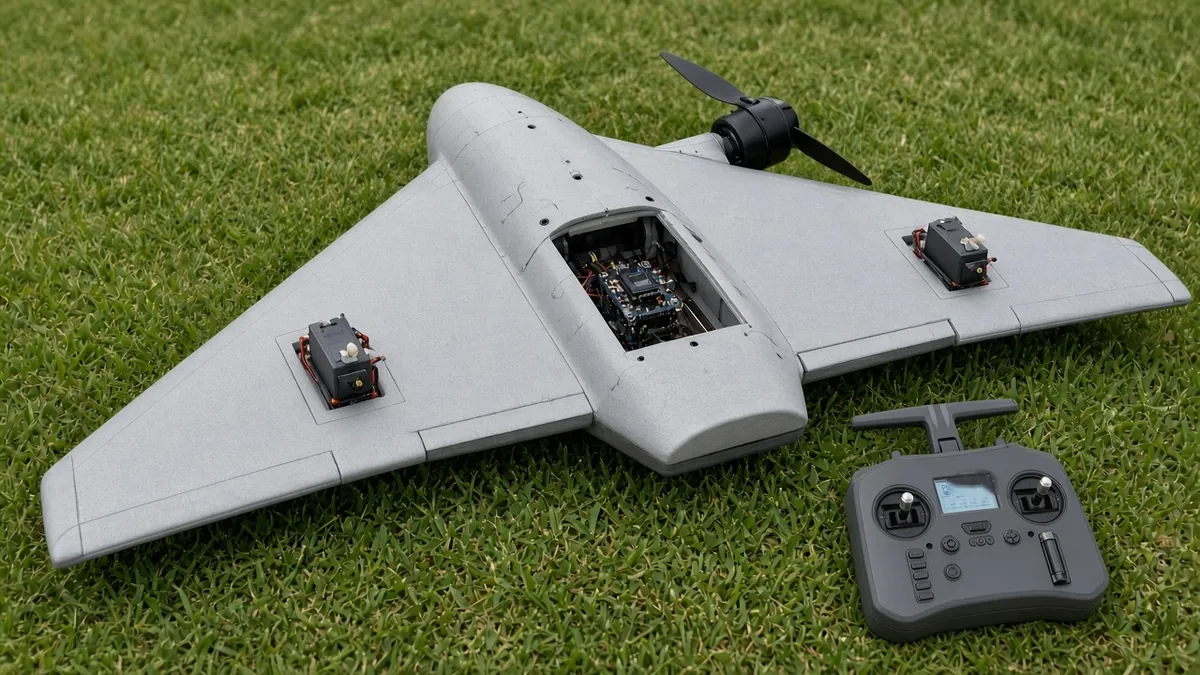
A foam-board or EPO wing with a small brushless motor, a couple of servos, a GPS, and official iNav on a wing flight controller. It cruises, holds a heading, and can return home when you set it up carefully.
Safety first
- A spinning prop at the front of a wing is dangerous. Keep clear of the arc during power-on, and do range and failsafe tests with the prop off or the aircraft restrained.
- Charge LiPo packs in a fire-safe bag, never unattended.
- Maiden into a large, empty, legal field, not a park full of people. Launch only with a working radio, a tested failsafe and enough space to glide if the motor quits.
- Weigh the finished aircraft including battery. Foam still counts.
Rules and laws
- In the US, every recreational flyer needs TRUST, whatever the aircraft weighs. Aircraft over 250 g ready to fly also need FAA registration and Remote ID. Confirm at https://www.faa.gov/uas. Some small foam planes come in under 250 g; yours might not.
- Use legal radio and, if you add FPV, legal video frequencies and a visual observer where required.
Parts
| Part | Qty | Approx. each | Subtotal |
|---|---|---|---|
| Foam-board, Flite Test-style, or EPO trainer or wing kitUse a documented plan or kit and credit the designer. Typical $15-40, no verified link.Amazon (search) | 1 | $25 | $25 |
| iNav-supported wing flight controller (F405-WING or F411-WING class with a published target)Confirm the official iNav target. Typical $30-55, no verified link.Amazon (search) | 1 | $40 | $40 |
| 9 g or 16 g control-surface servoTypical $3-8, no verified link.Amazon (search) | 2 | $5 | $10 |
| Brushless motor, propeller, and ESC sized to the airframe and a 2S-4S packTypical $20-45, no verified link.Amazon (search) | 1 | $30 | $30 |
| GPS module supported by your flight controllerMount it away from the ESC. Typical $12-25, no verified link.Amazon (search) | 1 | $18 | $18 |
| RadioMaster RP1 V2 ExpressLRS 2.4 GHz nano receiverTypical $18-$25 each (or see pack note). ASIN confirmed. Typical $18-25. Also sold at GetFPV; that page did not show a usable price in our fetch.Amazon | 1 | $22 | $22 |
| 2S-4S LiPo that fits the fuselageTypical $12-25, no verified link.Amazon (search) | 2 | $18 | $36 |
| ExpressLRS 2.4 GHz radio transmitter (e.g. RadioMaster Pocket)Skip if you already own an ExpressLRS radio. Typical $60-90, no verified link.Amazon (search) | 1 | $70 | $70 |
| Estimated total (parts only) | $251 | ||
Typical US prices, checked 2026-11-12. Prices change and multi-packs are often cheaper per piece.
As an Amazon Associate I earn from qualifying purchases. Prices change; check the store.
Filament
PLA (1.75 mm): about 25 g (8.4 m), roughly 2 h of printing.
PLA or PETG for a motor mount or control horns, 0.2 mm layers, 25% infill, supports if the mount has overhangs. The airframe is foam, not a printed fuselage.
AI agents you'll use
- iNav helper (ChatGPT, Claude, Gemini or Grok): Walks through official iNav Configurator steps for a flying wing or trainer: firmware target, control-surface direction, failsafe and a conservative auto-tune later, without inventing a CLI dump.
- Build helper: Checks motor, prop, battery and servo choices against the airframe plan you paste in.
Tools
- Hot glue gun and a sharp hobby knife
- Soldering iron
- Computer with official iNav Configurator
- Covering tape
- LiPo charger and a fire-safe bag
- Kitchen scale
What you'll learn
- Building a simple foam or EPO wing
- Flashing official iNav on a wing flight controller
- Control-surface direction, throws and failsafe
- Why a wing still has to obey the same weight and airspace rules as a quad
A foam wing is quieter and longer-legged than a tiny quad, and official iNav can hold a heading or return home once GPS and failsafes are set honestly. Most of the airframe is cut foam or a kit; printed parts, if any, are a motor mount or horns.
What you'll build
A small trainer or flying wing with a brushless motor, two (or more) servos, a wing flight controller running official iNav, a GPS, a receiver, and a pack that fits the fuselage. First flights are manual. Autopilot modes come after a calm maiden.
Print the parts
If the kit includes a motor mount and horns, you may not print anything. Otherwise search Printables or Thingiverse for a mount that matches your motor size (for example a 2212-class or whatever the plan actually calls for - check the plan), and credit the designer. Print in PLA or PETG with the settings above.
Wiring
Use the official pad diagram for your wing board. This is a role list.
| Function | Typical connection | Notes | |---|---| | Servos | Board servo outputs for elevons or aileron/elevator | Confirm direction in iNav with the motor unpowered or the prop off. | | ESC / motor | Motor output and battery through the ESC | Restrain the aircraft for first spin-up. | | GPS | A UART, mounted away from the ESC | Need a clear view of the sky. | | Receiver | A UART or the RC port | Set failsafe to a known safe behavior, often a glide or RTL once GPS modes are proven - follow iNav docs. | | Battery | The board or ESC power lead | Balance the pack in the fuselage as the plan shows. |
Flash official iNav for your board's published target.
Step-by-step
- Build the foam or EPO airframe from a documented plan or kit. Keep the control surfaces free and the center of gravity where the plan says.
- Mount the motor, ESC, servos and flight controller, with the GPS away from high-current wires.
- Flash official iNav, set the airframe type, and check surface direction with the prop off.
- Set throws, expo and failsafe. Confirm the radio disarms or cuts the throttle reliably.
- Weigh the finished aircraft with a battery and complete any required registration before an outdoor flight.
- Maiden manually in a large legal field, into the wind, with room to glide.
- After a successful manual flight, calibrate the compass and GPS outdoors, then try a gentle heading-hold or return mode at a safe altitude, still in empty airspace.
- Inspect tape, hinges, props and packs after every landing that was less than pretty.
Code
Official iNav, not an Arduino sketch.
Prompt for the helper:
Walk me through flashing official iNav to a wing flight controller, setting a flying-wing or trainer airframe type, checking elevon or aileron/elevator direction with the prop off, and configuring failsafe.
I will paste the official board target. Do not invent a CLI dump or PID/FF values. Point me back to the iNav documentation when you are unsure.
Troubleshooting
- It rolls in the wrong direction: swap a servo channel or reverse it in iNav, prop off, on the bench.
- Motor will not arm: a pre-arm check is failing (sensors, throttle hold, or a switch). Read the official iNav arming flags.
- RTL or heading hold is unreliable: no solid GPS fix, compass interference, or you tried an autopilot mode before a manual maiden.
- Center of gravity is off: the pack has slid. The plan's CG is not optional.
Files, code and docs
- iNav firmware repository (GPL-3.0)
- Flite Test (plans and foam-wing techniques) (Vendor docs)
- FAA Unmanned Aircraft Systems (Vendor docs)
Last checked 2026-11-12. Double-check parts against your own board and seller listings before you buy.