Robotic hand that copies your glove
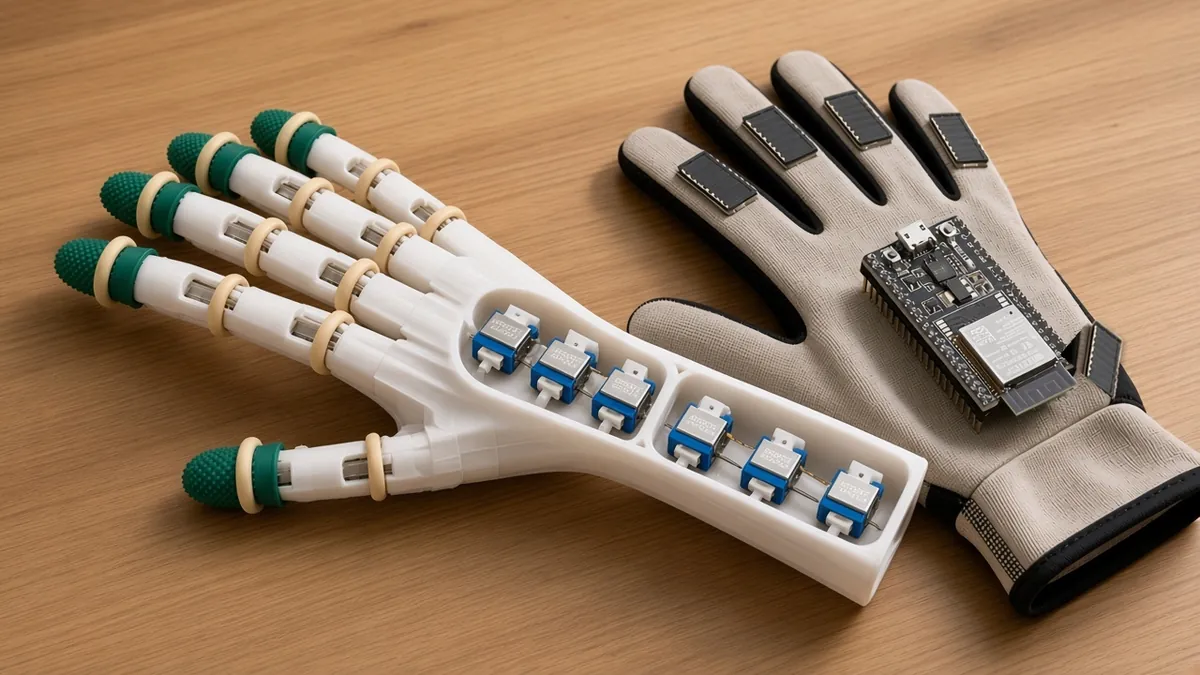
Bend your fingers in a glove fitted with five flex sensors and a printed five-finger hand copies you. One ESP32 reads the glove and sends the bends over ESP-NOW; a second ESP32 drives five MG90S servos that pull the fingers with fishing-line tendons.
Safety first
- Servos pull hard on the tendons. Keep fingers out of the printed hand while it is powered.
- Do not over-bend the flex sensors at their base; that is where they crack.
- Power the five servos from the 5 V 3 A supply, not the ESP32 board.
Parts
| Part | Qty | Approx. each | Subtotal |
|---|---|---|---|
| Espressif ESP32-DevKitC-32E (DevKitC V4) development boardTwo official DevKitC V4 boards: one in the glove, one in the hand. Official Espressif 38-pin DevKitC V4 with ESP32-WROOM-32E (4 MB). Micro-USB port, not USB-C. Buy only the official 38-pin Micro-USB board, not a USB-C or 30-pin clone. Primary listing: Mouser 356-ESP32-DEVKITC32E, $10.20, 1,701 in stock on Nov 12, 2026, per Findchips (https://www.findchips.com/search/ESP32-DEVKITC-32E). The Mouser US page itself returned 403 to a direct fetch, so click-confirm the US storefront before you order. Mouser Netherlands listed 1,622 in stock at €8.60 the same day. Do not use DigiKey as the default today (search snippets showed 0 in stock / long lead time). Official Amazon listing https://www.amazon.com/dp/B09MQJWQN2 was still unavailable; use it if it returns. Amazon search for the official board: https://www.amazon.com/s?k=ESP32-DevKitC-32E. Adafruit #3269 remains $15.00 and was out of stock (https://www.adafruit.com/product/3269). Typical $10-16.Mouser | 2 | $10.20 | $20.40 |
| 4.5-inch flex sensorOne per finger. Adafruit and SparkFun sell the Spectra Symbol original; cheaper clones vary. Typical $8-15, no verified link.Amazon (search) | 5 | $10 | $50 |
| MG90S metal-gear micro servo (10-pack)Five used, five spares. Confirm the chosen hand's pockets are MG90S/SG90 class before you print. Typical $22-35, no verified link.Amazon (search) | 1 | $28 | $28 |
| Resistor assortment kit (1/4 W)Five 47 k resistors for the flex-sensor dividers. Typical $7-13, no verified link.Amazon (search) | 1 | $10 | $10 |
| Cotton work gloves (pack)Typical $5-10, no verified link.Amazon (search) | 1 | $8 | $8 |
| Braided fishing line 50 lbTendons. Typical $7-12, no verified link.Amazon (search) | 1 | $9 | $9 |
| Round elastic cord 1 mmReturn springs that open each finger. Typical $4-8, no verified link.Amazon (search) | 1 | $6 | $6 |
| 5 V 3 A DC power supply with barrel adapterServo power for the hand. Typical $9-15, no verified link.Amazon (search) | 1 | $12 | $12 |
| Anker PowerCore 10000 USB power bankSkip if you already own one. Powers the glove ESP32. Typical $18-28, no verified link.Amazon (search) | 1 | $22 | $22 |
| 40-pin 20 cm female-to-female jumper wiresCatalog ASIN. Typical $4-8.Amazon | 1 | $5.50 | $5.50 |
| Estimated total (parts only) | $170.90 | ||
Typical US prices, checked 2026-11-12. Prices change and multi-packs are often cheaper per piece.
As an Amazon Associate I earn from qualifying purchases. Prices change; check the store.
Filament
PLA (1.75 mm): about 300 g (100.7 m), roughly 18 h of printing.
PLA, 0.2 mm layers, 20% infill, 3 walls. Print finger segments on their side so the hinge pins are strong.
AI agents you'll use
- Code helper (ChatGPT, Claude, Gemini or Grok): Writes both sketches: the glove sender (read five ADC pins, smooth, send over ESP-NOW) and the hand receiver (map to five servo angles).
- Calibration helper: Turns your logged open-hand and fist readings into per-finger min/max mapping values.
Tools
- Soldering iron
- Wire stripper
- Hot glue gun
- Needle and thread
- Small Phillips screwdriver
- USB-A to Micro-B data cable (official DevKitC V4 uses Micro-USB)
What you'll learn
- Reading flex sensors with a voltage divider
- ESP-NOW wireless between two ESP32 boards
- Mapping and smoothing sensor values
- Tendon-driven mechanisms
Make a fist and the robot hand makes a fist. This is a great way to learn sensors, wireless links and mechanisms in one build, and people love trying it on.
What you'll build
A life-size printed hand with five tendon-driven fingers and a forearm that holds five MG90S servos. Each servo pulls a fishing-line tendon to close one finger; an elastic cord on the back of each finger opens it. The glove has five flex sensors, read by an ESP32 that sends values about 50 times a second over ESP-NOW.
The cost range is $130-190. The low end assumes you already own these items marked "skip if you already own one": Anker PowerCore 10000 USB power bank. The high end includes them.
Print the parts
Do not default to InMoov. InMoov is a larger, different robot and is licensed CC BY-NC 3.0 — link it only if you specifically want that hand, and do not host or redistribute those files. Prefer a permissively licensed five-servo tendon hand. A flex-sensor-controlled design that matches this project is IntegratedFX's DIY Robotic Hand (Thingiverse 4291429), licensed CC BY (confirmed on the 3dgo.app Thingiverse mirror, Nov 12, 2026; re-check the live Thingiverse badge). Confirm the servo pockets fit MG90S (or SG90) before you print, and credit the designer. Print one finger and test the tendon path first.
Wiring
Glove side (ESP32 #1): each flex sensor forms a divider with a 47 k resistor. Use ADC1 pins, because ADC2 cannot be read while the Wi-Fi radio (and ESP-NOW) is running.
| From | To | Notes |
|---|---|---|
| Flex sensor (each) | 3V3 on one end, ADC pin on the other | Thumb GPIO32, index GPIO33, middle GPIO34, ring GPIO35, little GPIO36 (all ADC1). |
| 47 k resistor (each) | From that ADC pin to GND | Divider. |
| Glove ESP32 power | USB power bank | |
| Hand ESP32 GPIO13, 14, 25, 26, 27 | Servo signal, thumb to little | |
| Servo red wires | 5 V 3 A supply + | |
| Servo brown wires, supply - | Hand ESP32 GND | Common ground. |
Step-by-step
- Print one finger and test the tendon path with a servo by hand.
- Print the rest of the hand and forearm and string the tendons.
- Sew the flex sensors to the glove backs of the fingers, with strain relief at the base.
- Wire the glove dividers and log raw values for open hand and fist.
- Find the hand ESP32 MAC address and put it in the glove sketch.
- Flash the sender and receiver sketches and test one finger at a time.
- Tune each finger's min/max servo angle so the tendon never pulls the servo into a stall.
Code
Two Arduino-ESP32 sketches using the built-in ESP-NOW API and the ESP32Servo library.
Prompt for the code helper:
Write two Arduino-ESP32 sketches. Sender: read five flex sensors on GPIO32-36 (ADC1), apply a moving average, and send a 5-byte struct over ESP-NOW to MAC <paste> 50 times per second.
Receiver: on each packet, map each value from my calibrated min/max to a servo angle with per-finger limits, and write to servos on GPIO13, 14, 25, 26, 27 using ESP32Servo.
If no packet arrives for 500 ms, open the hand to a safe pose.
Troubleshooting
- Readings stuck at 0 or 4095: The pin is on ADC2 or the divider is miswired. Use GPIO32-36 and check the resistor.
- Finger closes but will not open: Add a return elastic or check the hinge is not too tight.
- Servo hums and heats: It is stalled against the tendon. Reduce that finger's max angle.
Print files
- DIY Robotic Hand — Arduino and flex-sensor controlled (IntegratedFX, CC BY. We don't host this file.)
Files, code and docs
- DIY Robotic Hand — Arduino and flex-sensor controlled (IntegratedFX, Thingiverse 4291429) (CC BY — credit the designer (confirmed on the 3dgo.app Thingiverse mirror, Nov 12, 2026; the live Thingiverse page itself failed to fetch))
- ESP-NOW documentation (Espressif) (Vendor docs)
- Installing the Arduino-ESP32 core (Espressif docs) (Vendor docs)
Last checked 2026-11-12. Double-check parts against your own board and seller listings before you buy.