GPS autopilot airboat with ArduPilot
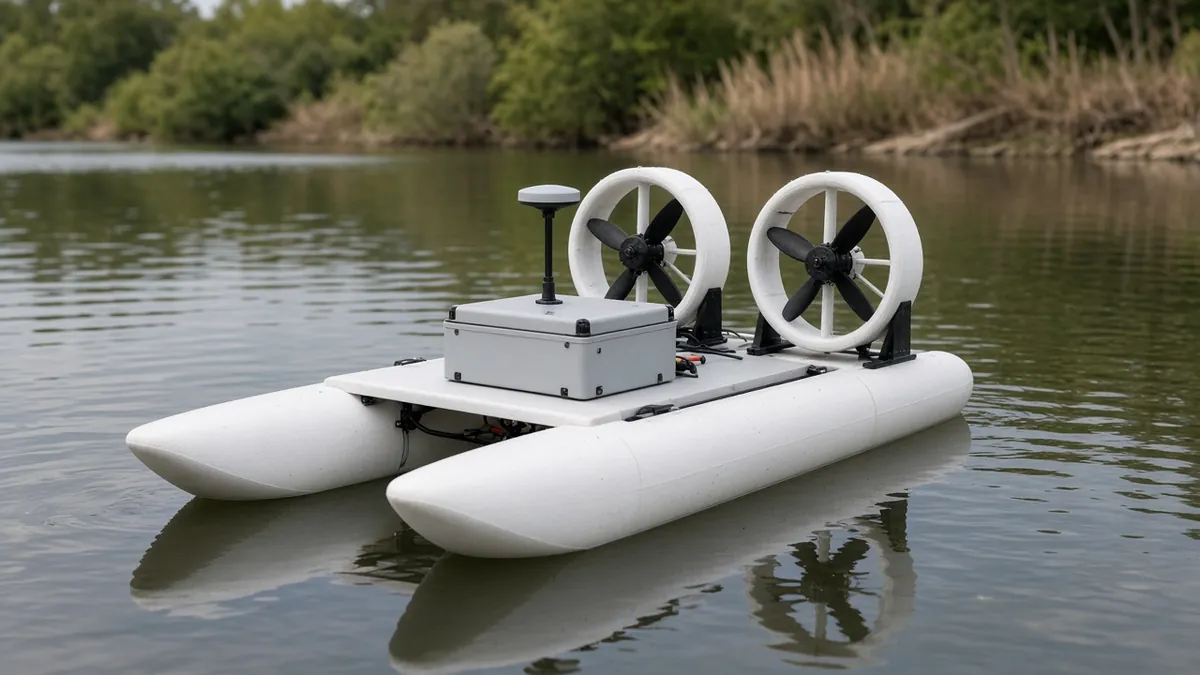
A foam twin-hull airboat pushed by two guarded air propellers, steered by differential thrust, and run by ArduPilot Rover on a Matek H743 board with an M10 GPS and compass. Drive it by radio, then let it follow a waypoint mission across a pond and come home.
Safety first
- Air props are dangerous. Fit the printed guards, keep props off while setting up on the bench, and arm only when the boat is on the water and pointed away from people.
- Charge LiPo packs in a fire-safe bag, never unattended. Keep the pack in the sealed box; a wet LiPo must be disposed of, not charged.
- Set a radio failsafe and a battery failsafe to Hold or RTL, and a geofence. Test RTL near shore first.
- Have a retrieval plan before the first launch. Never wade or swim after the boat in cold or deep water.
Rules and laws
- Check the rules of the pond or lake: many parks ban motorized models or require a permit. Stay clear of swimmers, anglers, boats and nesting birds.
- This is a surface boat, not an aircraft, so FAA drone rules do not apply. Use only legal 2.4 GHz radio gear.
Parts
| Part | Qty | Approx. each | Subtotal |
|---|---|---|---|
| Matek H743-WING V3 flight controllerHas an ArduPilot firmware target (MatekH743); confirm on firmware.ardupilot.org before buying. Typical $65-95, no verified link.Amazon (search) | 1 | $80 | $80 |
| Matek M10Q-5883 GPS and compass moduleTypical $28-45, no verified link.Amazon (search) | 1 | $35 | $35 |
| 2212 1400KV brushless motorTypical $9-16, no verified link.Amazon (search) | 2 | $12 | $24 |
| BLHeli_S 30A ESCMust be set to bidirectional (3D) mode so each motor can reverse for tight turns. Typical $9-16, no verified link.Amazon (search) | 2 | $12 | $24 |
| 8045 propellers, CW and CCW pairsTypical $6-12, no verified link.Amazon (search) | 1 | $8 | $8 |
| RadioMaster RP1 V2 ExpressLRS 2.4 GHz nano receiverCatalog ASIN. Typical $18-25.Amazon | 1 | $22 | $22 |
| RadioMaster Pocket ExpressLRS radio transmitterSkip if you already own one. Typical $60-90, no verified link.Amazon (search) | 1 | $70 | $70 |
| 3S 11.1 V 2200 mAh LiPo with XT60Typical $20-32, no verified link.Amazon (search) | 1 | $25 | $25 |
| XPS foam insulation board, 1 inchHome-improvement stores sell 2 x 8 ft sheets for less. Typical $12-30, no verified link.Amazon (search) | 1 | $20 | $20 |
| IP65 waterproof junction box (small)Holds the flight controller, receiver and battery. Typical $7-14, no verified link.Amazon (search) | 1 | $10 | $10 |
| XT60 connector pairs (5-pack)Typical $6-10, no verified link.Amazon (search) | 1 | $8 | $8 |
| LiPo voltage checker with low-voltage alarmTypical $4-9, no verified link.Amazon (search) | 1 | $6 | $6 |
| ToolkitRC M6 LiPo balance chargerSkip if you already own one. Needs a 12-24 V DC supply (many people use a laptop-style 19 V brick). Typical $35-50, no verified link.Amazon (search) | 1 | $40 | $40 |
| ToolkitRC ADP180 180 W 19.5 V power supply (XT60)Skip if you already own one. Powers the DC-only M6 charger from a wall outlet; skip it if you already have a 12-28 V DC supply with an XT60 lead. Typical $30-50, no verified link.Amazon (search) | 1 | $40 | $40 |
| LiPo fire-safe charging bagTypical $8-15, no verified link.Amazon (search) | 1 | $10 | $10 |
| Estimated total (parts only) | $422 | ||
Typical US prices, checked 2026-11-12. Prices change and multi-packs are often cheaper per piece.
As an Amazon Associate I earn from qualifying purchases. Prices change; check the store.
Filament
PETG (1.75 mm): about 150 g (49.5 m), roughly 8 h of printing.
PETG, 0.2 mm layers, 30% infill, 4 walls for motor mounts and prop guards. PETG handles sun and water better than PLA.
AI agents you'll use
- Code helper (ChatGPT, Claude, Gemini or Grok): Explains the ArduPilot Rover parameters for a skid-steer boat (frame class boat, left/right throttle outputs, failsafe and RTL) and checks a parameter list you paste against the current docs.
- Mission planner helper: Helps you plan a short, legal waypoint mission well away from swimmers, boats and wildlife, and sets a geofence.
Tools
- Soldering iron for XT60 and motor leads
- Hot-wire or sharp knife for foam
- Multimeter
- Computer with Mission Planner or QGroundControl
- LiPo balance charger and a fire-safe bag
- A way to retrieve the boat (long net, kayak or a friend with a boat)
What you'll learn
- Setting up ArduPilot Rover for a skid-steer boat
- GPS and compass calibration
- Planning and running waypoint missions
- Failsafes and return-to-launch
An autopilot boat is the friendliest way into ArduPilot: it cannot fall out of the sky, it moves slowly, and watching it drive a square on a pond by itself is very satisfying.
What you'll build
A twin-hull foam airboat about 60 cm long. Two motors with air props sit side by side at the back, so there are no shafts or seals in the water. ArduPilot Rover mixes them for skid steering: both forward to go straight, one faster to turn. A Matek H743-WING V3 runs ArduPilot, the M10Q-5883 gives GPS and heading, and an ELRS receiver gives you manual control and a failsafe.
The cost range is $240-465. The low end assumes you already own these items marked "skip if you already own one": RadioMaster Pocket ExpressLRS radio transmitter, ToolkitRC M6 LiPo balance charger, ToolkitRC ADP180 180 W 19.5 V power supply (XT60). The high end includes them.
Print the parts
Print motor mounts, round prop guards and a mast for the GPS. Search Printables for a 2212 motor mount and a prop guard that fits 8-inch props, or ask the AI helper to help you design simple ones. Credit any designer you use.
Wiring
| From | To | Notes |
|---|---|---|
| 3S LiPo XT60 | Flight controller power input and both ESCs | Follow the Matek wiring diagram for the board's battery pads. |
| ESC left / right signal | Flight controller motor outputs S1 / S2 | Set as ThrottleLeft / ThrottleRight in ArduPilot. |
| Motors | ESC outputs | Swap two wires if a motor spins the wrong way. |
| M10Q-5883 GPS | A GPS UART plus the I2C pads (compass) | Mount on the mast, away from motor wires. |
| RP1 receiver | A free UART | Set the serial protocol to RC input. |
| Voltage alarm | LiPo balance lead |
Step-by-step
- Cut two foam hulls and a deck, glue them, and seal the foam with paint or tape.
- Mount motors, guards, the waterproof box and the GPS mast.
- Flash ArduPilot Rover for the MatekH743 target with Mission Planner. Props off.
- Set the frame type to boat and the outputs to ThrottleLeft and ThrottleRight. Put both ESCs in bidirectional (3D) mode and calibrate.
- Bind the ELRS receiver and set the radio and battery failsafes. Set a geofence.
- Calibrate the accelerometer and compass with the boat assembled.
- Float-test without props for leaks and balance. Then drive it in Manual mode close to shore.
- Try Hold and RTL near shore, then a 3-waypoint Auto mission.
Code
No sketch: ArduPilot Rover is configured with parameters in Mission Planner or QGroundControl.
Prompt for the code helper:
I am setting up ArduPilot Rover on a Matek H743-WING V3 for a twin air-prop skid-steer boat with two bidirectional BLHeli_S ESCs on outputs 1 and 2, an M10Q-5883 GPS/compass and an ELRS receiver.
List the parameters to set (frame class, servo functions, failsafes, geofence, RTL) with a one-line reason each, using the current ArduPilot Rover docs.
Do not invent parameter names; tell me which ones to confirm in the docs for my firmware version.
Troubleshooting
- Boat circles in Auto: Compass is off or interfered with. Raise the GPS mast and recalibrate.
- One motor will not reverse: That ESC is not in bidirectional mode. Reflash its settings.
- Wanders off line in wind: Air boats are wind-sensitive. Tune the steering rate and navigation gains slowly, one at a time.
Files, code and docs
- ArduPilot firmware repository (GPL-3.0)
- ArduPilot Rover documentation (Vendor docs)
- Mission Planner (Vendor docs)
Last checked 2026-11-12. Double-check parts against your own board and seller listings before you buy.