Kinetic sand table that draws patterns with a magnet
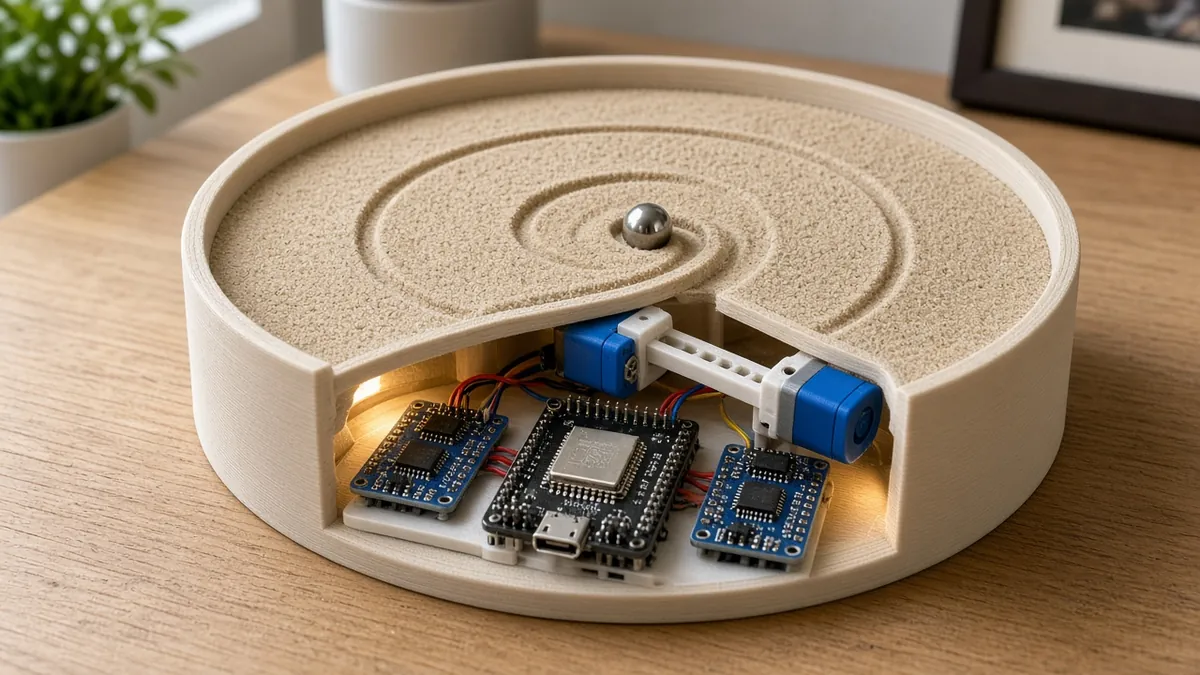
A desktop kinetic sand table based on the free Mini Dune Weaver: a hidden magnet under a printed tray drags a steel ball through fine sand to draw spirals and mandalas. Two 28BYJ-48 steppers and an ESP32 run the official Mini firmware; you control it from a web browser.
Safety first
- Strong neodymium magnets pinch skin hard and can damage cards, phones and pacemakers. Keep them away from children, who must never swallow magnets.
- Keep fingers out of the gears while it runs.
- Use a listed USB power adapter. Keep sand out of the electronics and off the gears.
Parts
| Part | Qty | Approx. each | Subtotal |
|---|---|---|---|
| Espressif ESP32-DevKitC-32E (DevKitC V4) development boardThe official Mini BOM calls for a generic ESP32 board. Official DevKitC V4 is 38-pin with Micro-USB; the assembly guide mentions a USB-C cable, so you may need to open the printed USB slot. Official Espressif 38-pin DevKitC V4 with ESP32-WROOM-32E (4 MB). Micro-USB port, not USB-C. Buy only the official 38-pin Micro-USB board, not a USB-C or 30-pin clone. Primary listing: Mouser 356-ESP32-DEVKITC32E, $10.20, 1,701 in stock on Nov 12, 2026, per Findchips (https://www.findchips.com/search/ESP32-DEVKITC-32E). The Mouser US page itself returned 403 to a direct fetch, so click-confirm the US storefront before you order. Mouser Netherlands listed 1,622 in stock at €8.60 the same day. Do not use DigiKey as the default today (search snippets showed 0 in stock / long lead time). Official Amazon listing https://www.amazon.com/dp/B09MQJWQN2 was still unavailable; use it if it returns. Amazon search for the official board: https://www.amazon.com/s?k=ESP32-DevKitC-32E. Adafruit #3269 remains $15.00 and was out of stock (https://www.adafruit.com/product/3269). Typical $10-16.Mouser | 1 | $10.20 | $10.20 |
| 28BYJ-48 5 V stepper motor with ULN2003 driver (5-pack)The Mini needs two motor-and-driver pairs; a 5-pack leaves spares. Typical $10-18, no verified link.Amazon (search) | 1 | $13 | $13 |
| N52 neodymium disc magnet 16x8 mm (pack)Official Mini BOM: a strong N52 magnet, 16x8 mm or smaller. You can model a tighter insert in the slicer if your magnet is smaller. Typical $7-14, no verified link.Amazon (search) | 1 | $10 | $10 |
| Carbon or stainless steel balls, 6-10 mm (pack)Official Mini BOM size. One ball is used on the sand. Typical $6-12, no verified link.Amazon (search) | 1 | $8 | $8 |
| BT3x10 self-tapping SHCS screws (20-pack)Official Mini BOM fastener. Choose the BT3x10 size. Typical $6-12.Bambu Lab | 1 | $8 | $8 |
| Small rubber O-ring assortmentThe official assembly guide uses a small O-ring on the big gear; pick the size shown in the guide. Typical $5-10, no verified link.Amazon (search) | 1 | $7 | $7 |
| 40-pin 20 cm female-to-female jumper wiresCatalog ASIN. Typical $4-8.Amazon | 1 | $5.50 | $5.50 |
| 5 V 2 A USB wall adapterThe whole table is powered through the ESP32 USB port. Typical $5-10, no verified link.Amazon (search) | 1 | $7 | $7 |
| USB-A to Micro-B data cableNeeded for the official DevKitC V4. Typical $4-8, no verified link.Amazon (search) | 1 | $6 | $6 |
| Fine white sand, 5 lbListed as optional on the official Mini BOM; baking soda also works. A thin, dry layer is enough. Typical $8-16, no verified link.Amazon (search) | 1 | $12 | $12 |
| 1 m LED strip (WS2812B or similar)Skip if you already own one. Optional under-table lighting from the official Mini BOM. Print the LED diffuser plate if you use it. Typical $6-14, no verified link.Amazon (search) | 1 | $10 | $10 |
| 10-inch clear acrylic discSkip if you already own one. Optional cover from the official Mini BOM. Typical $7-15, no verified link.Amazon (search) | 1 | $10 | $10 |
| Estimated total (parts only) | $106.70 | ||
Typical US prices, checked 2026-11-12. Prices change and multi-packs are often cheaper per piece.
As an Amazon Associate I earn from qualifying purchases. Prices change; check the store.
Filament
PLA (1.75 mm): about 412 g (138.3 m), roughly 9 h of printing.
PLA, 0.2 mm layers, 15% infill, 2 walls; these are the official Mini Dune Weaver designer-profile settings (4 plates, about 9.2 h and 412 g including the optional LED diffuser).
AI agents you'll use
- Code helper (ChatGPT, Claude, Gemini or Grok): Helps you flash the current Mini Dune Weaver firmware from the official wiki or First Weave docs, and reads serial logs when the motors do not home.
- Pattern helper: Writes small Python scripts that generate .thr theta-rho pattern files (spirals, roses, star shapes) to upload in the web app.
Tools
- Small screwdriver
- Soldering iron or pre-crimped Dupont jumpers
- USB-A to Micro-B data cable (official DevKitC V4 uses Micro-USB)
- Computer to flash the Mini firmware
What you'll learn
- Polar (theta-rho) motion
- Driving 28BYJ-48 steppers from an ESP32
- Flashing open-source sand-table firmware
- Pattern files and playlists
A steel ball rolls slowly through sand, drawing a new pattern every few minutes and erasing the last one. It is calming, endlessly varied, and one of the best conversation pieces you can build.
What you'll build
This build follows the free Mini Dune Weaver by Tuan Nguyen, a printed desktop table about 25 cm (10 in) across. The lower base holds the electronics; the upper tray holds a thin layer of sand and a steel ball. Two 28BYJ-48 steppers on ULN2003 drivers move the magnet in polar coordinates (theta around the center, rho in and out). An ESP32 is the brain, powered by a single USB cable. No Raspberry Pi, DLC32 or NEMA 17 motors are required for this model — those belong to the paid Mini Pro, which is a different machine.
The cost range is $75-120. The low end assumes you already own these items marked "skip if you already own one": 1 m LED strip (WS2812B or similar), 10-inch clear acrylic disc. The high end includes them.
Print the parts
Download the Mini Dune Weaver files from Tuan Nguyen's MakerWorld listing (model 896314) and credit the designer. The listing uses MakerWorld's Standard Digital File License (personal use; no hosting, no redistribution, no commercial use of the files or prints). We do not host these files. Follow the official assembly guide on that page: BT3x10 screws into the motors, drivers mounted upside down, a small O-ring on the big gear. Designer profile: 0.2 mm layers, 2 walls, 15% infill, about 9.2 h and 412 g of PLA (including the optional LED diffuser plate). Use the latest gears from the January 2025 update; older gears need older firmware.
Wiring
| From | To | Notes |
|---|---|---|
| ESP32 5V / GND | 5V and GND on both ULN2003 boards | The table is powered from the ESP32 USB port. |
| Outer 28BYJ-48 (pins 1-4) | ULN2003, then ESP32 GPIO 14, 12, 26, 27 | Official Mini assembly guide. GPIO 12 is a strapping pin; that is the official mapping, so keep the motor disconnected while flashing if the board will not boot. |
| Center 28BYJ-48 (pins 1-4) | ULN2003, then ESP32 GPIO 16, 17, 18, 19 | Official Mini assembly guide. Note which driver is in the center and which is on the outside. |
| USB wall adapter | ESP32 USB port | Micro-USB on the official DevKitC V4. Face the connector out through the printed cover. |
Step-by-step
- Download the Mini Dune Weaver files from MakerWorld and read the assembly PDF and the Dune Weaver wiki.
- Print the official plates (base, sand tray, gears; LED diffuser only if you added the strip) using the designer profile.
- Mount the two 28BYJ-48 motors with BT3x10 self-tapping screws, gently so the screw bosses do not break.
- Wire both ULN2003 boards as in the guide, mount them upside down, and fit the ESP32 cover.
- Add the O-ring, gears and in-out arm, then the table top, a thin layer of sand and the steel ball.
- Flash the current Mini firmware from the official wiki (and check First Weave at duneweaver.com/install only if the current Mini docs say to use it).
- On power-up the ball should crash-home all the way in; then load a pattern from the web UI.
Code
Use the official Mini Dune Weaver firmware and web app from tuanchris/dune-weaver and the project wiki — not a generic FluidNC + Raspberry Pi setup, which is for other Dune Weaver models. Your own patterns are .thr text files of theta and rho pairs.
Prompt for the code helper:
Write a Python script that generates a Dune Weaver .thr pattern file: one theta (radians) and rho (0.0 center to 1.0 edge) pair per line.
Make a rose curve with 7 petals that starts at rho 0 and ends at rho 1, with points close enough that each step moves less than 1 degree, and print the number of lines.
Then explain how to upload it in the current Dune Weaver Mini web app.
Troubleshooting
- Ball loses the magnet: Sand is too deep or the magnet is too weak or too far below the tray. Use a thin sand layer and a magnet that still fits the 16x8 mm pocket.
- ESP32 will not flash or boot with the outer motor wired: GPIO 12 is a strapping pin. Unplug that motor while flashing, then reconnect.
- Patterns drift or look distorted: Reprint the latest gears from the January 2025 update and use matching firmware. Check that the outer and center motors are not swapped.
- Nothing moves, or it homes the wrong way: The official boot sequence is the ball trying to go all the way in. Recheck the pin map and which driver is in the center.
Print files
- Mini Dune Weaver (Tuan Nguyen, MakerWorld Standard Digital File License. We don't host this file.)
Files, code and docs
- Mini Dune Weaver print files (Tuan Nguyen, MakerWorld 896314) (Standard Digital File License — link only, do not host or redistribute)
- Dune Weaver software (tuanchris/dune-weaver) (GPL-3.0 (dual-licensed; commercial license available))
- Dune Weaver Mini wiki and assembly notes (Vendor docs)
- Dune Weaver docs (Vendor docs)
Last checked 2026-11-12. Double-check parts against your own board and seller listings before you buy.