Robot dog with 12 servos
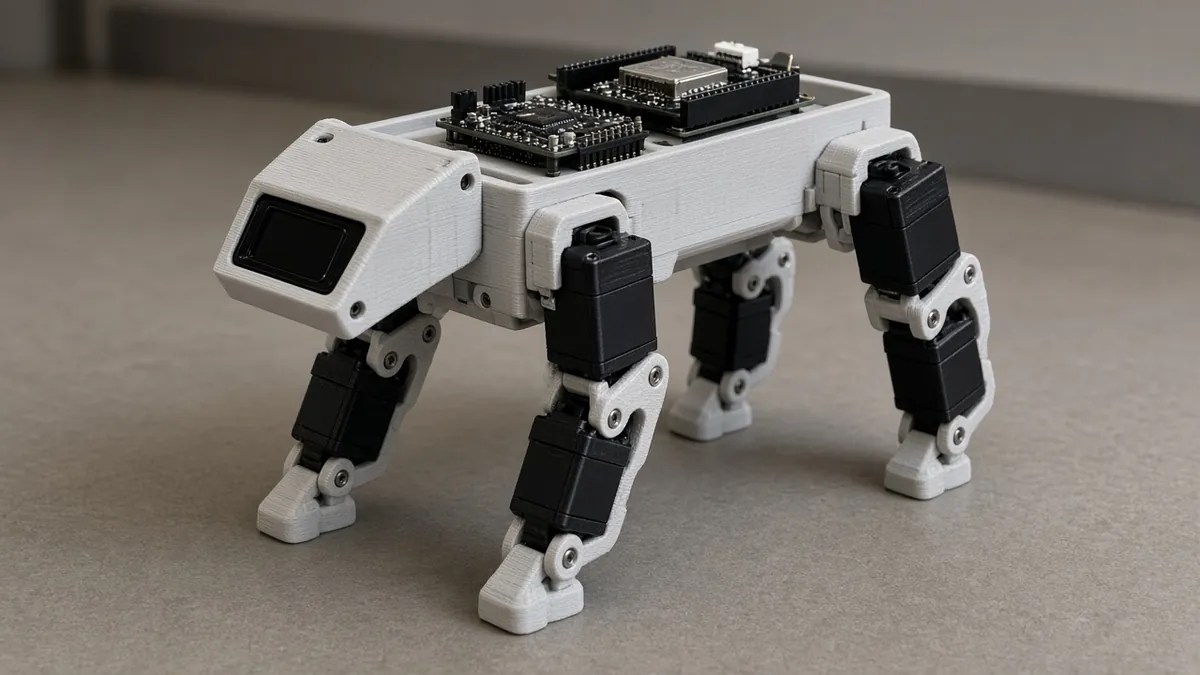
A printed four-legged robot dog using Deok-yeon Kim's original SpotMicro frame: 12 JX PDI-HV5523MG high-voltage servos (three per leg), a PCA9685 servo board, an MPU-6050 for balance and an ESP32 brain, powered by a 2S LiPo.
Safety first
- These servos are strong (about 19-23 kg-cm). Keep fingers out of the joints whenever the battery is connected, and add a power switch you can reach.
- Charge LiPo packs in a fire-safe bag, never unattended. Do not charge a damaged or swollen pack, and stop when the alarm beeps.
- PDI-HV5523MG is rated about 6.0-8.4 V. Power the PCA9685 servo V+ rail from the 2S pack (about 7.4 V). Do not feed 7.4 V into the PCA9685 VCC logic pin or the ESP32.
- Use 14-16 AWG wire on the servo power rail. Thin jumper wires get hot at these currents.
Parts
| Part | Qty | Approx. each | Subtotal |
|---|---|---|---|
| JX PDI-HV5523MG 23 kg high-voltage digital servo12 needed (three per leg). Fits the official `_cls` SpotMicro parts (same pockets as CLS6336HV). Price seen $23.85 each (in stock, ships in 4-5 days, Nov 12, 2026). This listing states a 120° maximum angle. SpotMicro under a PCA9685 needs near-180° travel (mike4192 commands about ±82.5° from center). Keep this servo only if you confirm 180° travel on a control board; mike4192 did use PDI-HV5523MG in these pockets successfully. The documented 180° option with the same `_cls` pockets is the JX CLS6336HV (official sheet: 120° on an RC radio, 180° on a control board). Verified alternate: JX Servo Ecoboost CLS6336HV, Amazon https://www.amazon.com/dp/B092ZJNT91, $45.00 each, in stock, usually ships in 4-5 days (Nov 12, 2026). Buy one set or the other, not both. Typical $20-28.Amazon | 12 | $23.85 | $286.20 |
| HiLetgo PCA9685 16-channel servo driverPrice seen $8.99 in our parts catalog (Nov 12, 2026). Typical $7-12.Amazon | 1 | $8.99 | $8.99 |
| Espressif ESP32-DevKitC-32E (DevKitC V4) development boardOfficial Espressif 38-pin DevKitC V4 with ESP32-WROOM-32E (4 MB). Micro-USB port, not USB-C. Buy only the official 38-pin Micro-USB board, not a USB-C or 30-pin clone. Primary listing: Mouser 356-ESP32-DEVKITC32E, $10.20, 1,701 in stock on Nov 12, 2026, per Findchips (https://www.findchips.com/search/ESP32-DEVKITC-32E). The Mouser US page itself returned 403 to a direct fetch, so click-confirm the US storefront before you order. Mouser Netherlands listed 1,622 in stock at €8.60 the same day. Do not use DigiKey as the default today (search snippets showed 0 in stock / long lead time). Official Amazon listing https://www.amazon.com/dp/B09MQJWQN2 was still unavailable; use it if it returns. Amazon search for the official board: https://www.amazon.com/s?k=ESP32-DevKitC-32E. Adafruit #3269 remains $15.00 and was out of stock (https://www.adafruit.com/product/3269). Typical $10-16.Mouser | 1 | $10.20 | $10.20 |
| HiLetgo GY-521 MPU-6050 IMU (3-pack)Mounted flat in the body for pitch and roll. Catalog ASIN, sold as a 3-pack. Typical $9-14.Amazon | 1 | $10.50 | $10.50 |
| LM2596 buck converter module (4-pack)One module set to 5 V powers the ESP32 and the PCA9685 logic (VCC), not the servo rail. Typical $7-13, no verified link.Amazon (search) | 1 | $10 | $10 |
| 2S 7.4 V 5200 mAh LiPo with XT60PDI-HV5523MG is a high-voltage servo (about 6.0-8.4 V). Feed the PCA9685 servo V+ rail from this pack, not from a 6 V buck. Typical $28-45, no verified link.Amazon (search) | 1 | $35 | $35 |
| XT60 connector pairs (5-pack)Typical $6-10, no verified link.Amazon (search) | 1 | $8 | $8 |
| LiPo voltage checker with low-voltage alarmTypical $4-9, no verified link.Amazon (search) | 1 | $6 | $6 |
| F625zz flange ball bearings (10-pack)Official SpotMicro hardware list uses 8× F625zz (not plain 625ZZ). Typical $6-12, no verified link.Amazon (search) | 1 | $8 | $8 |
| M4 screw and nut assortment (includes M4x20 and M4x15)Official list: 40× M4x20, 8× M4x15, 48× M4 nuts. Typical $10-18, no verified link.Amazon (search) | 1 | $14 | $14 |
| M5x15 screws (pack)Official list: 8× M5x15. Typical $4-9, no verified link.Amazon (search) | 1 | $6 | $6 |
| M3 screw and nut assortment kitOfficial list: 4× M3x20, 28× M3x10, 16× M3 nuts. Typical $10-18, no verified link.Amazon (search) | 1 | $14 | $14 |
| ToolkitRC M6 LiPo balance chargerSkip if you already own one. Needs a 12-24 V DC supply (many people use a laptop-style 19 V brick). Typical $35-50, no verified link.Amazon (search) | 1 | $40 | $40 |
| ToolkitRC ADP180 180 W 19.5 V power supply (XT60)Skip if you already own one. Powers the DC-only M6 charger from a wall outlet; skip it if you already have a 12-28 V DC supply with an XT60 lead. Typical $30-50, no verified link.Amazon (search) | 1 | $40 | $40 |
| LiPo fire-safe charging bagTypical $8-15, no verified link.Amazon (search) | 1 | $10 | $10 |
| Estimated total (parts only) | $506.89 | ||
Typical US prices, checked 2026-11-12. Prices change and multi-packs are often cheaper per piece.
As an Amazon Associate I earn from qualifying purchases. Prices change; check the store.
Filament
PETG (1.75 mm): about 900 g (297 m), roughly 45 h of printing.
PETG (or PLA for indoor use), 0.2 mm layers, 30% infill, 4 walls for the leg and shoulder parts, supports as the official SpotMicro files specify.
AI agents you'll use
- Code helper (ChatGPT, Claude, Gemini or Grok): Writes the 12-servo channel map, leg inverse kinematics and a trot gait for the ESP32, and explains each function.
- Mechanical review helper: Checks your print set against the official SpotMicro BOM: `_cls` parts, the non-mega plate, F625zz bearings and the published screw list.
Tools
- Soldering iron
- Hex and Phillips drivers
- Multimeter
- Wire stripper
- USB-A to Micro-B data cable (official DevKitC V4 uses Micro-USB)
- LiPo balance charger and a fire-safe bag
What you'll learn
- Leg inverse kinematics for a quadruped
- Trot and walk gaits
- Using an IMU to level the body
- High-current servo power distribution
A robot dog is the build everyone stops to watch. This version uses the original open SpotMicro frame: a printed body, four legs with three servos each, and a gait you develop step by step with an AI helper.
What you'll build
A quadruped about 35-40 cm long, built from Deok-yeon Kim's SpotMicro files. Each leg has a shoulder, an upper leg and a lower leg joint, all PDI-HV5523MG servos in the official _cls pockets (the same size as CLS6336HV). One PCA9685 drives all 12 servos; the ESP32 runs inverse kinematics and reads the MPU-6050 so the body can stay level while standing. Print the non-mega body plate — the default plate is cut for an Arduino Mega and will not fit this electronics stack. You may need a small adapter to mount the ESP32 and PCA9685 on that plate.
If you choose the 180° CLS6336HV servos instead of the PDI-HV5523MG, add about $255 (12 x $21.15 more per servo); that build costs more than the $380-560 range shown here.
The cost range is $380-560. The low end assumes you already own these items marked "skip if you already own one": ToolkitRC M6 LiPo balance charger, ToolkitRC ADP180 180 W 19.5 V power supply (XT60). The high end includes them.
Print the parts
Download the original SpotMicro files by Deok-yeon Kim (KDY0523) from Thingiverse thing 3445283 (CC BY — credit the designer). Print the _cls parts, the unmarked common parts, and the non-mega plate. Do not print the Mega plate for this build, and do not use the MG (_mg) parts with these servos. The STLs in mike4192/spotMicro are for RViz, not for printing. Print one leg and one shoulder first and test-fit a servo before committing to the full print.
Wiring
| From | To | Notes |
|---|---|---|
| XT60 battery lead | PCA9685 V+ screw terminal (servo rail) and LM2596 input | Alarm on the balance lead. The 2S pack goes to the servo rail only, not to PCA9685 VCC. |
| LM2596 output (5 V) | ESP32 5V/VIN and PCA9685 VCC | Logic power when untethered. |
| PCA9685 SDA / SCL | ESP32 GPIO21 / GPIO22 | Shared I2C bus. |
| MPU-6050 SDA / SCL | ESP32 GPIO21 / GPIO22 | Address 0x68. |
| Servos (12) | PCA9685 channels 0-11 | Three per leg; keep a written map. |
| All grounds | Common GND | Battery, LM2596, PCA9685, MPU and ESP32. |
Step-by-step
- Download the official
_clsand non-mega files, print and test-fit one leg, then print the rest. - Set the LM2596 to 5.0 V with a multimeter, no load attached. Do not put a 6 V regulator on the servo rail.
- Wire the 2S pack to the PCA9685 servo V+ rail, and 5 V logic to the ESP32 and PCA9685 VCC; run an I2C scanner and confirm 0x40 (PCA9685) and 0x68 (MPU-6050).
- Center all 12 servos with a test sketch before attaching horns. Use hot glue on the horns as the original designer specifies.
- Assemble the legs with the F625zz bearings and the official screw list, and write down each servo's channel and trim offset.
- Get one leg tracking a foot position with the AI-written inverse kinematics, robot on a stand.
- Add a stand-up and sit-down sequence, then a slow walk gait (one leg at a time).
- Add a trot gait (diagonal pairs) only after the walk is stable.
- Use the MPU-6050 to level the body while standing on a slight slope.
Code
Arduino-ESP32 with the Adafruit PCA9685 library and any maintained MPU-6050 library. The mike4192/spotMicro repository is a ROS reference for kinematics and gait ideas (it used PDI-HV5523MG in these same _cls parts, usually on a Raspberry Pi); this build ports the ideas to an ESP32 rather than running ROS.
Prompt for the code helper:
Write an Arduino sketch for an ESP32 quadruped with 12 PDI-HV5523MG servos on one PCA9685 (channels 0-11, three per leg: shoulder, upper, lower) and an MPU-6050 at 0x68.
Include: a channel map, per-servo trims, a 3-joint leg IK function with my link lengths as constants, stand/sit sequences, a slow walk gait and a body-leveling loop using pitch and roll.
Ramp every move, clamp angles to safe limits, and add a serial command to cut all servo signals.
Troubleshooting
- Robot collapses when it stands: The servo rail is sagging or the gait asks for too much torque. Check voltage under load and lower the body height. MG996R-size servos are too weak in this frame — use PDI-HV5523MG or CLS6336HV.
- Walks in a curve: Trim offsets differ left to right. Re-center and re-measure each leg.
- IMU readings jump: Mount the MPU-6050 on foam tape, away from the servo wires, and filter the readings.
- Electronics do not fit the body plate: You printed the Arduino Mega plate. Reprint the non-mega plate and add a mount for the ESP32 and PCA9685.
Print files
- SpotMicro (Deok-yeon Kim / KDY0523, CC BY. We don't host this file.)
Files, code and docs
- SpotMicro print files (Deok-yeon Kim / KDY0523, Thingiverse 3445283) (CC BY — credit the designer; redistribution allowed with attribution)
- SpotMicroAI getting-started and hardware notes (Vendor docs)
- SpotMicro software reference (mike4192/spotMicro, ROS-based) (MIT)
- Adafruit PCA9685 PWM servo driver library (BSD)
- Installing the Arduino-ESP32 core (Espressif docs) (Vendor docs)
Last checked 2026-11-12. Double-check parts against your own board and seller listings before you buy.