Voice-controlled 4-DOF robot arm
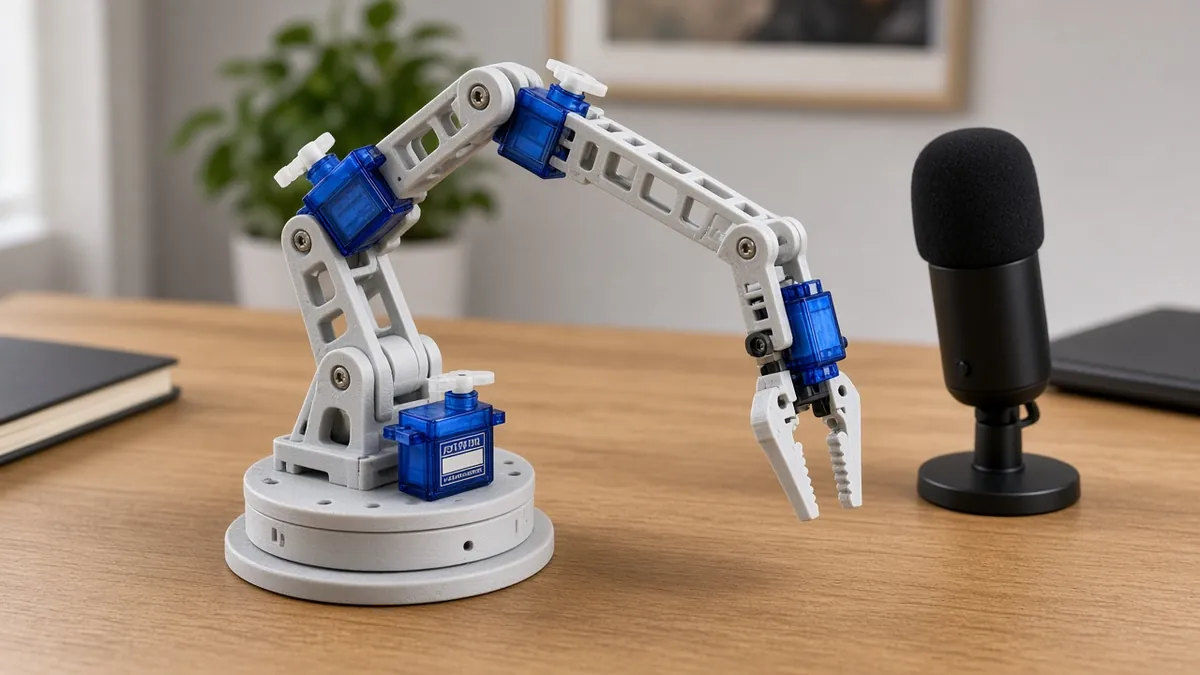
A printed desktop arm with four SG90 servos that waves, homes, and grips when you say a short command. An ESP32 moves the joints; a computer running Whisper turns speech into serial orders.
Safety first
- Power the servo rail from a current-limited 5 V supply, not from the ESP32 USB 5 V pin.
- SG90s heat and can break if they stall against a printed stop or try to lift anything heavy. Keep software limits inside the mechanical range.
- Pinch hazard at the gripper and elbow. Keep fingers clear during tests.
- Voice control can misfire. Use a wake word or a button, and never point the gripper at faces.
- This is a low-voltage project. No mains wiring.
Parts
| Part | Qty | Approx. each | Subtotal |
|---|---|---|---|
| Espressif ESP32-DevKitC-32E (DevKitC V4) development boardOfficial Espressif 38-pin DevKitC V4 with ESP32-WROOM-32E (4 MB). Micro-USB port, not USB-C. Buy only the official 38-pin Micro-USB board, not a USB-C or 30-pin clone. Primary listing: Mouser 356-ESP32-DEVKITC32E, $10.20, 1,701 in stock on Nov 12, 2026, per Findchips (https://www.findchips.com/search/ESP32-DEVKITC-32E). The Mouser US page itself returned 403 to a direct fetch, so click-confirm the US storefront before you order. Mouser Netherlands listed 1,622 in stock at €8.60 the same day. Do not use DigiKey as the default today (search snippets showed 0 in stock / long lead time). Official Amazon listing https://www.amazon.com/dp/B09MQJWQN2 was still unavailable; use it if it returns. Amazon search for the official board: https://www.amazon.com/s?k=ESP32-DevKitC-32E. Adafruit #3269 remains $15.00 and was out of stock (https://www.adafruit.com/product/3269). Typical $10-16.Mouser · price seen on 2026-11-12 | 1 | $10.20 | $10.20 |
| HiLetgo PCA9685 16-channel 12-bit PWM servo driverDefault I2C address is often 0x40; confirm with a scanner. Price seen ~$8.99 on Amazon, Nov 12, 2026. Price seen $8.99 (4.5 stars, 273 reviews in search results). Adafruit's official board (product 815) was listed unavailable on Amazon.Amazon · price seen on 2026-11-12 | 1 | $8.99 | $8.99 |
| SG90 9 g micro servo (Beffkkip 5-pack)Light objects only. This is not a metal-gear industrial arm. Price seen ~$1.98 on Amazon, Nov 12, 2026. Price seen $9.88 for a 5-pack (4.4 stars, 1792 reviews in search results).Amazon · price seen on 2026-11-12 | 4 | $1.98 | $7.92 |
| 5 V, 3 A (or better) DC power supplyDo not power the servo rail from USB. Typical $10-18 for a listed 5 V supply, no verified link.Amazon (search) | 1 | $12 | $12 |
| USB microphoneOptional if your computer already has a mic. Typical $10-25, no verified link.Amazon (search) | 1 | $15 | $15 |
| M3 screws, standoffs, and jumper wiresTypical $4-8 for a small hardware kit, no verified link.Amazon (search) | 1 | $5 | $5 |
| Estimated total (parts only) | $59.11 | ||
Typical US prices, checked 2026-11-12. Prices change and multi-packs are often cheaper per piece.
As an Amazon Associate I earn from qualifying purchases. Prices change; check the store.
Filament
PLA (1.75 mm): about 150 g (50.3 m), roughly 10 h of printing.
PLA for the first fit (PETG is tougher for the base and shoulder if you will use the arm often), 0.4 mm nozzle, 0.2 mm layers, 25% infill, 3 walls, supports on the gripper and any horizontal pin holes.
AI agents you'll use
- Code helper (ChatGPT, Claude, Gemini or Grok): Writes the PCA9685 command parser and a small Python script that maps spoken words to serial commands, then fixes errors you paste back in.
- Mechanical check helper: Reviews link lengths and warns which poses are likely to stall a 9 g servo.
- Wiring checker: Confirms the servo supply is on the PCA9685 terminal block and that I2C pins and a common ground are correct.
Tools
- 3D printer
- Small Phillips screwdriver
- Calipers or a ruler
- Computer with Arduino IDE and Python 3
- USB data cable
- USB microphone if your computer has no mic
What you'll learn
- Driving several servos from a PCA9685 so the microcontroller is not the power source
- Setting software travel limits so 9 g servos do not stall
- A tiny serial command protocol
- Hooking a local speech model to a real mechanism
This is a classroom-size arm, not a workshop manipulator. Four SG90 servos move a printed base, shoulder, elbow and gripper. You type or speak short words like HOME, WAVE, GRAB and RELEASE. Speech recognition runs on a laptop or a Raspberry Pi you already have, using a local Whisper build; the ESP32 only moves the joints.
What you'll build
A 4-DOF printed arm with a simple gripper, a PCA9685 servo driver, an ESP32, and a 5 V, 3 A supply. Reach is typically under about 25 cm. It can wave, return to a home pose, and pick up a scrap of foam or a paperclip, not a bottle or a tool.
The cost range assumes you already have a computer (or a Pi) to run Whisper. Add a USB microphone only if you need one.
Print the parts
Search Printables or Thingiverse for an open-licensed "4-DOF SG90 robot arm" and credit the designer. Check link lengths, horn types, and whether the file actually expects MG90S metal-gear servos before you force SG90s into the pockets.
Print the base and links with the settings above. Dry-fit every servo. Confirm each joint can sweep without the horn hitting a printed stop. Use the horns that ship with the servos unless the design includes replacements that match the SG90 spline.
Wiring
| From | To |
|---|---|
| PCA9685 VCC | ESP32 3.3 V (some boards accept 5 V VCC - read the silkscreen) |
| PCA9685 SDA, SCL | GPIO 21, GPIO 22 |
| PCA9685 GND | Common ground with the ESP32 and the 5 V supply |
| PCA9685 terminal V+ | External 5 V, 3 A supply |
| PCA9685 terminal GND | External 5 V supply ground |
| Base / shoulder / elbow / gripper signal wires | PCA9685 channels 0, 1, 2, 3 |
| ESP32 USB | Computer USB port (serial commands) |
On many PCA9685 boards the terminal-block V+ feeds the servo-header V+. Leave that jumper as the board designer intended and power from the terminal block, not from the ESP32.
Step-by-step
- Print and assemble the arm, mounting each servo in the middle of its mechanical range (the HOME pose, usually around 90° in the sketch) before you screw on the links.
- Install the Arduino IDE, the ESP32 core, and the Adafruit PWM Servo Driver library.
- Wire the PCA9685 and the 5 V, 3 A supply. Confirm a common ground.
- Flash a tiny sketch that sends HOME, then very small angle changes, with the arm unloaded.
- Set software min and max for each joint so the linkage never binds.
- From the computer, send the same commands over USB serial with a short Python script.
- Install a local Whisper build (whisper.cpp is a common choice) and map a tiny phrase list to HOME, WAVE, GRAB and RELEASE.
- Test with a scrap of foam. Add a switch on the 5 V servo supply so you can cut power if a joint runs away.
Code
Prompt for the code helper:
Write an Arduino-ESP32 sketch that talks to a PCA9685 at I2C address 0x40 (SDA 21, SCL 22) at 50 Hz.
Map serial commands HOME, WAVE, GRAB and RELEASE to four SG90 channels 0-3.
Use clearly labeled pulse-length limits (Adafruit's library often starts around 150-600 ticks - I will measure my servos and tighten the range).
Do not power-on into a pose that yanks a joint against a stop. Comment the code for a beginner.
Then, on the computer:
Write a short Python script that opens the ESP32 serial port at 115200 baud, listens to the microphone with a local Whisper model, and writes one of HOME, WAVE, GRAB, RELEASE plus a newline when it hears a matching phrase. Ignore unmatched speech.
Get keyboard serial commands working before you add the microphone.
Troubleshooting
- A servo hums and gets hot: it is stalling. Loosen the horn, widen the printed clearance, and tighten the software limits.
- Nothing moves, OLED-less board looks dead: run an I2C scanner for 0x40, and check VCC vs the terminal-block V+.
- ESP32 resets when several joints move: the servo supply is sagging or is still coming from USB. Use the 3 A supply.
- Whisper fires the wrong command: shrink the phrase list and require a button or wake word.
Files, code and docs
Last checked 2026-11-12. Double-check parts against your own board and seller listings before you buy.